


Think tank targets charities’ campaigning role

Howard Lake | 31 July 2026 | News
A report from a right-leaning think tank has set out a detailed programme to strip charitable status from organisations whose main activity it deems to be political campaigning. In addition it proposes making campaigning expenditure taxable, and cutting off the flow of public money to charities that litigate or campaign against government policy.
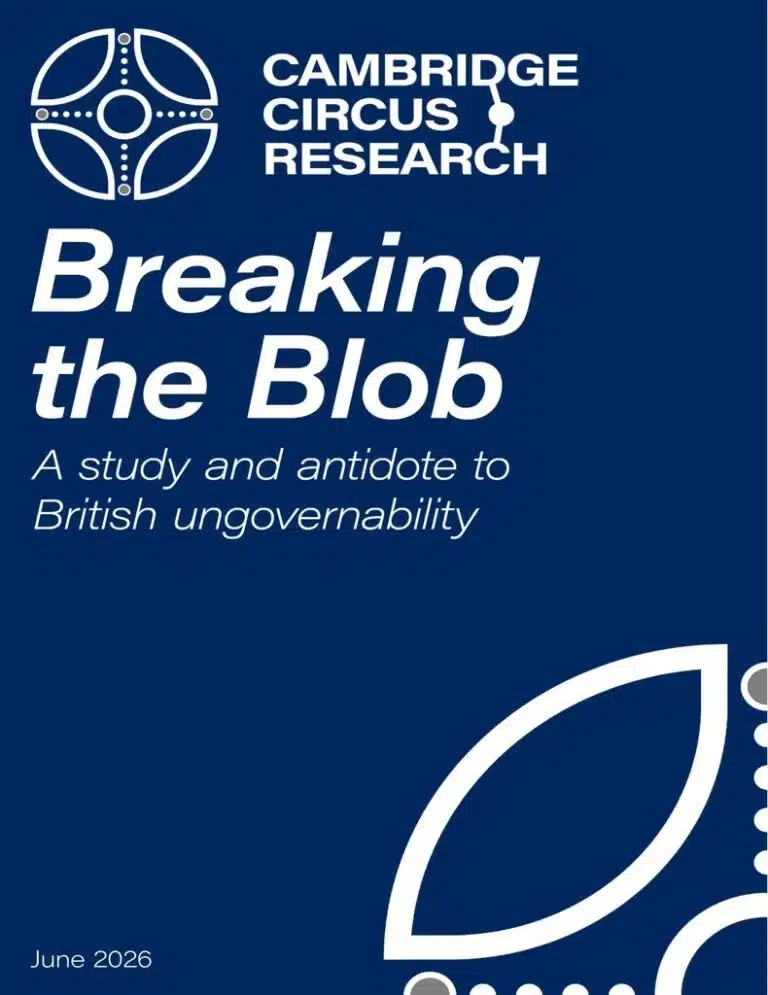
Breaking the Blob: A Study and Antidote to British Ungovernability is the debut paper from Cambridge Circus Research, written by “Charles Talbot and Zack Salisbury” and published in June 2026.
It argues that parts of the UK charity, NGO, foundation and public-interest litigation sector operate as a coordinated, durable political force that frustrates elected policy without equivalent transparency or accountability, a situation it describes as “a state at war with itself”.
Advertisement
Cambridge Circus Research states that its focus research areas are defence, education and governance.
What the report proposes
The paper accepts that charities may campaign and scrutinise government, and states that charitable activity is not inherently improper. Its recommendations, however, are far-reaching.
They include:
- a statutory “charitable neutrality test” in the Charities Act 2011 that would deny charitable status where political campaigning becomes an organisation’s dominant, strategic or recurring purpose;
- a narrowing of broad charitable purposes such as human rights and equality to concrete, auditable activity;
- and a “grassroots-majority” income test under which advocacy charities keep their privileges only where most of their advocacy income comes from members and small donors rather than foundations, state grants or regranting intermediaries.
The report also calls for:
- a default prohibition on discretionary public grants to campaigning charities
- mandatory annual “political-activity returns”
- compulsory disclosure of grants and regrants
- and for campaigning expenditure to be treated as non-charitable and taxable.
It argues that the Charity Commission, responsible for more than 170,000 charities with only 457 staff, is not equipped to enforce charity law, and should be reconstituted closer to its pre-2006 form with stronger enforcement powers.
Immigration and asylum supply most of its case studies, from the Rwanda scheme to Labour’s UK-France returns arrangement, though it extends the model to climate, protest, equality and procurement.
A report with a political objective
The paper is not a neutral piece of sector analysis. It is addressed explicitly to current and future ministers as a “governing programme” and “legislative reform programme”, with a foreword by former Cabinet Office adviser Fred de Fossard and acknowledgements to figures associated with the online political right. Its authors write under pen names.
Its reception confirms the point. In the weeks after publication it was amplified almost exclusively through partisan outlets, including the Daily Sceptic, which called it “important, shocking and radicalising”, alongside The Conservative Woman, spiked and The Critic.
Much of that coverage focused on funding to organisations working on trans issues, Net Zero and immigration, framing the sector as a “vast web of policy influence”.
The use of unspecific, ill-defined but emotive terms such as “blob” and “woke” are a hallmark of some right-of-centre critiques of organisations and individuals with whom they disagree.
The document has a clear destination in view: the removal or narrowing of the campaigning freedoms, tax reliefs and public funding on which large parts of the charity sector depend.
Echoes of the US playbook
The report does not emerge in isolation, and it is candid about its inspiration. Its foreword praises the transparency drive of the DOGE initiative in the United States, and its central “state funds its own opponents” argument closely tracks the rhetoric deployed against American nonprofits over the past 18 months.
Since January 2025 the Trump administration has pursued a series of actions against US nonprofits, including a federal funding freeze, DOGE grant terminations, executive orders targeting particular programme areas, and threats to revoke tax-exempt status. A congressional subcommittee held a hearing pointedly titled “Public Funds, Private Agendas: NGOs Gone Wild“, and charitable status has been threatened in cases including Harvard. A coalition of more than 3,700 nonprofits condemned the campaign as unlawful and un-American. The parallels with Breaking the Blob’s language of publicly funded “opposition loops” are clear.
The sector’s position
No charity umbrella body appears to have responded directly to this report at the time of writing, probably on the grounds of not responding to anonymously written articles. There has been some debate amongst charity leaders and advisors on LinkedIn.
Nevertheless the sector’s stance on the themes it raises is already on the record. NCVO reported in June that hostility and intimidation are forcing charities into what its chief executive Kate Lee called “protection mode”, diverting resources into resilience and safeguarding.
In April, NCVO, ACEVO, Oxfam, the Runnymede Trust, the Muslim Charities Forum and Quakers in Britain warned in an open letter to ministers of a “gradual shrinking of civic space“, citing concern over broad and ambiguous grounds for action against charities. Sector academics have separately warned that charities are increasingly used as “pawns in culture wars“.
The right to campaign in support of a charitable mission remains settled in charity law.
Charity Commission and NCVO guidance is clear that charities can support or oppose specific policies where this furthers their charitable purposes. Breaking the Blob is an argument for changing that settlement, and fundraisers, foundations and campaigning charities should recognise this white paper as an opening move rather than as a one-off provocation.
Transparency
The report makes much of the need for transparency. But the think tank’s website and the report share little in terms of who runs the organisation, who funds it, and who might have funded this research.
The ‘about’ section has no names on it, and the one news release (for this report) gives no named contact or phone number, just a function-related email of ca*********************@********il.com.
It is hard to determine the political or research background of authors “Charles Talbot and Zack Salisbury”. Both surnames are reminiscent of a former Lord High Chancellor and a Conservative Prime Minister.
“Cambridge Circus Research” might suggest an office on central London’s Cambridge Circus, or indeed another Cambridge Circus. But the website and indeed the press release yield no physical or postal address or even a PO box for the think thank. Not surprisingly this has led to speculation that it is a reference to the location of John Le Carré’s fictional British intelligence service, led by someone using the codename ‘Control’.
The researchers are happy to name names in their research, using publicly available data on charity trustees. Appendix A1 is a ‘Trustee ecosystem table’ which shows the “trustee and board-member overlaps [which] illustrate the personnel network connecting migration, civil-liberties, environmental, development, and legal advocacy organisations”. It names the individuals and the “charities/organisations served on”. On the assumption that that refers to current and past appointments, most trustees and board members will have served or be serving on more than one charity’s board. In the same way that commercial board members and non-exec directors do.
Interestingly these individuals’ board roles are only on display here. There is no reference to the role that any of them might have had or have advising commercial sector boards.
In terms of transparency about senior charity leaders, the report is also accompanied on the website with two interactive visualisations, on “Iranian-linked UK charity & protest networks” and another on ‘Who’s Who in Charity Land’. Neither seem to be functioning at this point. Both display the message (on 31 July) “The interactive file for this visualisation has not yet been added to assets/vis/“.
The names of who is associated with Cambridge Circus Research are matched by the absence of detail on who funds the organisation, at least on its website, and in its debut report. If this were published by a registered charity it would not have met our criteria for coverage.
- Isle of Eigg accepts secure credit card donations online (23 September 1996)
- Funding advice site launched for advocacy organisations (2 July 2012)
- Restrictions on non-profit advocacy around world could deter ‘new middle class’ from giving (27 May 2014)
Related posts
New guidance on legal proceedings issued by Charity Commission
Charity Commission clarifies new powers to issue warnings
Charity Commission inquiry secures £1 million for charitable grants

Charities can use social media for political campaigning, Commission’s new guidance confirms

About Howard Lake
Howard Lake is consultant editor of UK Fundraising. He founded the site in 1994 and successfully sold it in 2022. As director of Giving X Ltd he is exploring growing giving on a massive scale.
He is the founder of Fundraising Camp and co-founder of GoodJobs.