


Brain study reveals what limits our compassion for large-scale and overseas crises

Howard Lake | 28 July 2026 | News
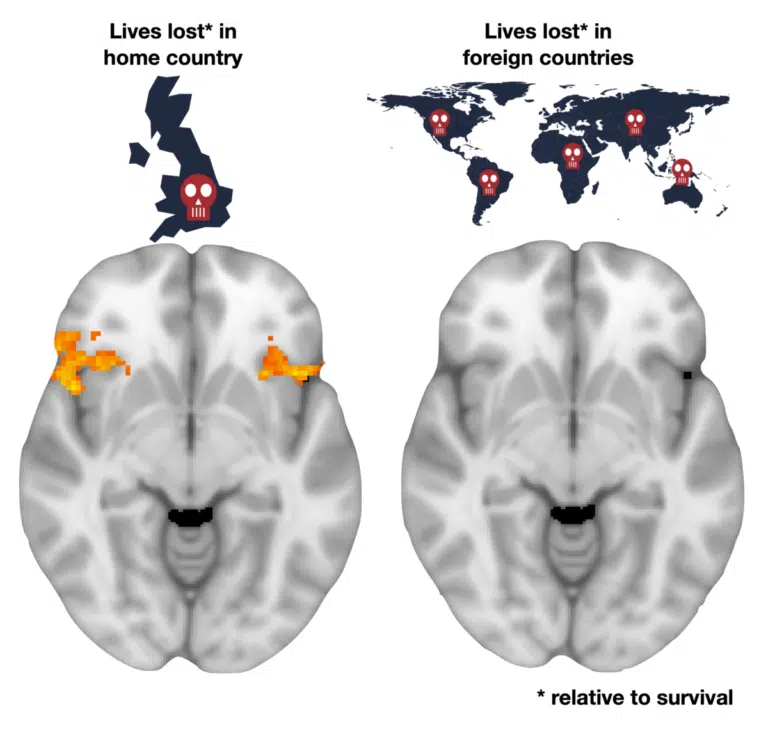
New neuroscience research from the University of Sussex offers fundraisers a biological explanation for two of the sector’s most stubborn challenges: why public concern so often fails to scale with the size of a disaster, and why crises overseas struggle to move donors as much as those closer to home.
The study, published in the journal Social Cognitive and Affective Neuroscience, used MRI scans to examine how the brain processes information about real threats to human life. Researchers Dr Dan Campbell-Meiklejohn and Dr Jo Cutler found that neural responses were surprisingly muted both for large numbers of lives at risk and for lives lost abroad, patterns the team links to two well-known phenomena in charitable giving: scope insensitivity and home-country bias.
Reading headlines
British participants were scanned as they read 200 headlines describing real events in which anywhere from a single person to tens of thousands were at risk, either in the UK or in one of 56 other countries. They then learned whether those people had survived or died. As a comparison, participants also tracked genuine financial risks to their own entries in a real cash prize draw.
Advertisement
The contrast was stark. Brain activity linked to financial risk scaled up naturally as the sums grew larger, while responses to human lives moved in the opposite direction, broadly decreasing as the number of people at risk rose, wherever in the world they were. For lives abroad, the researchers found a distinctive “inverted-U” pattern: a very low response to a single life at risk overseas, a higher response for moderate numbers, and then a collapse again for the largest numbers of victims.
The team also found that the brain’s emotion-related regions responded more strongly to deaths than to survivals, but only when the victims were in the participant’s home country. For events abroad, those same regions showed no measurable distinction between people living and dying.
Dr Campbell-Meiklejohn, Associate Professor of Psychology and Director of the Social Motivation Lab at Sussex, said the biases may stem from human evolution in small groups facing nearby threats, or from the media environment that shapes our brains. “Living up to values that all lives matter equally may require all of us, especially policy makers and communicators, to work together to overcome these limits and save more lives both at home and abroad,” he said.
Patterns rather than single explanation
The researchers caution that brain scans reveal patterns of activity rather than a single explanation for behaviour. Follow-up responses suggested participants who favoured local events often did so because those events felt more likely to affect them or people they know. This suggests that self-protection, as well as differences in empathy, may play a part.
For fundraisers and campaigners, the findings reinforce a familiar lesson with fresh biological weight: statistics alone rarely mobilise generosity, and appeals built around single, identifiable individuals may work with the grain of the brain rather than against it.
The paper, Diminished neural responses for greater numbers of lives at risk and lives lost in foreign countries, in Social Cognitive and Affective Neuroscience, Volume 21, Issue 1, 2026, is open access. Dr Campbell-Meiklejohn is keen to take the work forward through funding bids and collaborations with media organisations; he can be contacted via the University of Sussex.
Related posts

Fundraisers invited to participate in Rogare research into ‘donor dominance’

Manifesto report highlights ‘engagement gap’ with donors
Benchmarking study puts WWF in first place for third sector provider of customer service
No evidence that charging for services weakens charity legitimacy

About Howard Lake
Howard Lake is consultant editor of UK Fundraising. He founded the site in 1994 and successfully sold it in 2022. As director of Giving X Ltd he is exploring growing giving on a massive scale.
He is the founder of Fundraising Camp and co-founder of GoodJobs.