


Manifesto report highlights ‘engagement gap’ with donors

Howard Lake | 27 November 2025 | News
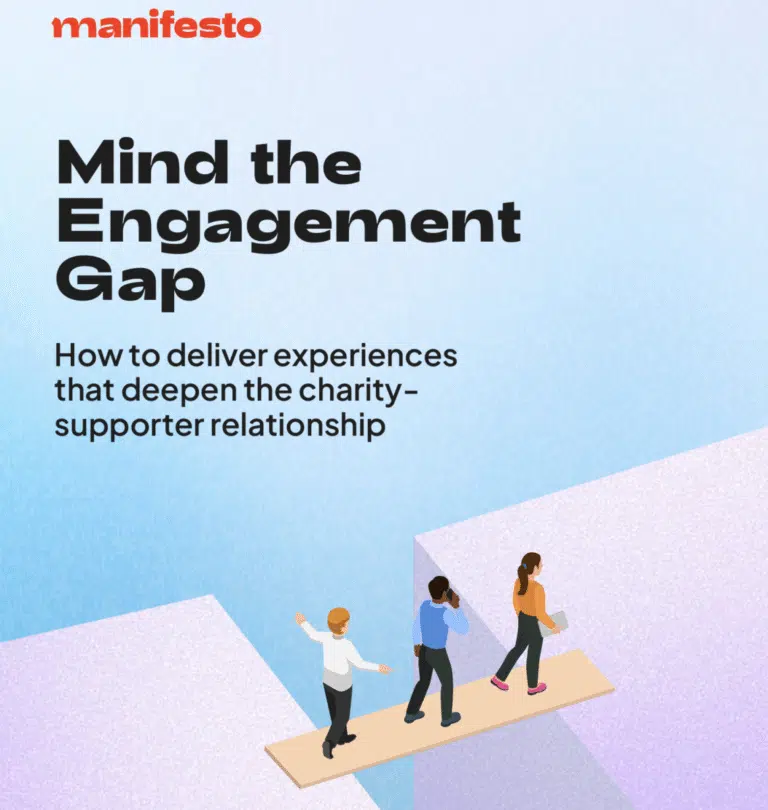
Digital experience agency Manifesto has published a report into the drivers of a decline in regular giving, with suggestions for charities on how to reverse it.
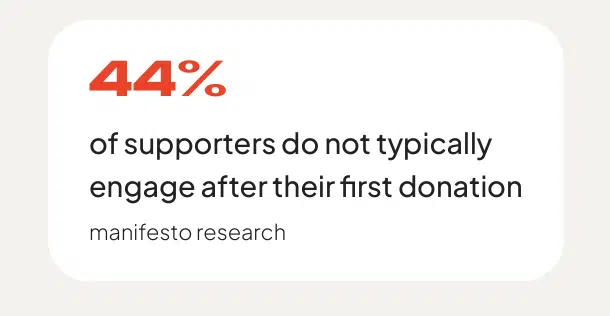
UK charities are facing “an existential threat due to a critical supporter engagement gap”, according to research by Manifesto. They say that “nearly half of all first-time donors [are] failing to make a second donation”, and point to research that has seen four million fewer UK adults donate since 2019.
The report, Mind The Engagement Gap: How to Deliver Experiences that Deepen the Charity-Supporter Relationship, is based on research with 2,000 supporters and 300 charity professionals.
Advertisement
Why so many supporters give just once
The research identifies three primary reasons why so many supporters are one-time-only donors to individual charities.
- Overwhelm and over-messaging: 61% of supporters disengage because charities “ask too often or too forcefully.” This is compounded by a high volume of communications, with 40% citing “too many messages and emails.” The data shows charities sent an average of 62 email messages per subscriber in 2024, a 9% increase over the previous year.
- Lack of impact visibility: 31% of supporters say that they disengage if they do not know how their donation is used. This habit is particularly significant amongst older donors, with 72% of those aged 65 or over rating trust and confidence in the effective use of donations as their top priority.
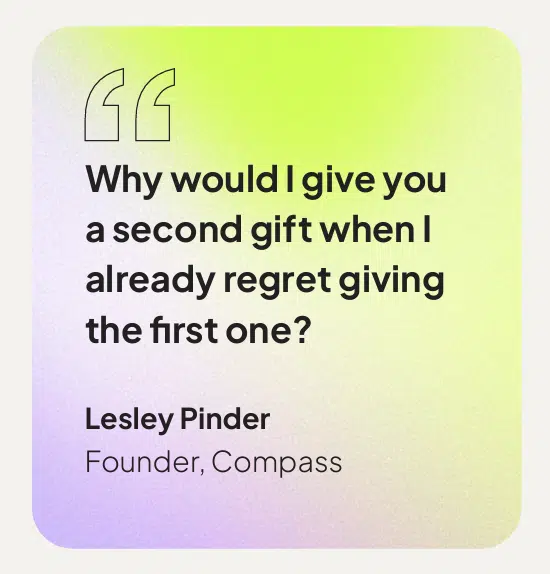
- Erosion of trust and values: 51% of supporters say they would stop engaging if they lost trust in a charity’s reputation, and 35% would disengage if the charity’s values no longer aligned with their own.
This trend and challenge is not of course news to charity leaders: 94% of charity leaders surveyed said they were ready to improve engagement. Yet internal operational hurdles are preventing effective change. Only 42% of leaders said that they felt “very ready” with the necessary resources and strategy.
Three barriers to overturning the challenge
The research presents three types of internal gaps that are preventing effective supporter experiences:
- The technology and data gap: Disconnected systems and fragmented data which prevent charities from knowing supporters well enough to serve their needs.
- The decision gap: Decision-making driven by organisational needs rather than supporter needs, where data is collected but not used effectively.
- The team and skills gap: Siloed teams and competing organisational priorities that result in fragmented experiences for supporters rather than coherent journeys.
What charities can do
The 80-page report doesn’t focus purely on the challenges. Indeed, it opens with “A letter of hope to the charity sector”. And the final page shows a version of the front page in which the gap has closed and donors are crossing it comfortably.
Manifesto argues that “improving supporter engagement rests on the quality of their digital experience”.
With one in five (18%) of supporters saying how they engage depends on the quality of their experience, charity organisation leaders need to work together to:
- meet donor needs
- cultivate their passion for the cause
- and prioritise the delivery of great digital experiences to drive success.
The report features practical case studies and insights from leading institutions that Manifesto say “have successfully navigated these transformations”, including:
- RNIB
- Trussell
- WWF
- Prostate Cancer UK
- and Compass.
Specifically the report urges charities to seek to earn long-term loyalty by prioritising supporter control, respect, impact visibility, values alignment, and motivation recognition. It outlines six key actions to achieve this:
- Make impact visible and personal: Connect support to the difference it’s made on outcomes through personalised impact communications
- Measure satisfaction consistently: Use pulse surveys to measure the experience, to tailor when the experience is strong, and detect disengagement early
- Build genuine preference centres: Offer real control over frequency of communications, channel and content
- Balance asks with impact: Coordinate across teams to protect supporter relationships. Don’t chase volume of asks, but use data to identify the propensity to take actions
- Understand and serve motivations: Capture motivations and tailor communications to serve them throughout the supporter experience
- Honour transparency: Publish commitments and demonstrate accountability
Louise Lai, Chief Client and Transformation Officer, manifesto, said:
“Engagement is fragile; hard to build and easy to break. But closing the gap between what supporters need and the experiences we deliver is a truly impactful opportunity for the sector to overcome today’s turbulent challenges. We do this by first closing the internal gaps within our organisations, which allows us to build meaningful, authentic connections with supporters. Our report is a letter of hope to the charitable sector, outlining practical, actionable steps to turn first-time givers into lifelong advocates.”
Ruth Doyle, Director of Digital and Content, WWF, added:
“Closing the engagement gap isn’t just about sending fewer emails. It’s about fundamentally shifting how we think about the supporter experience. People don’t just want to give money for you to make change, they want to feel part of that change and they need to see and feel what their money achieves.
“Charities must confront the cultural road block of risk aversion – we must do better at being comfortable with technology projects, understanding and being able to respond dynamically to opportunities.”
The report can be downloaded for free from Manifesto in return for providing your contact details.
About the research
Sector research was commissioned by manifesto and Renegade Media Ltd, and conducted by Censuswide, a member of the Market Research Society and The British Polling Council. It took place between 19 and 26 August 2025 and attracted 304 respondents.
Consumer research was conducted by YouGov from a sample of 2,000 respondents across the UK between 2 and 9 September 2025.

About Howard Lake
Howard Lake is consultant editor of UK Fundraising. He founded the site in 1994 and successfully sold it in 2022. As director of Giving X Ltd he is exploring growing giving on a massive scale.
He is the founder of Fundraising Camp and co-founder of GoodJobs.