


Charities encouraged to sign a Donor Code of Conduct pledge

Howard Lake | 21 November 2025 | News
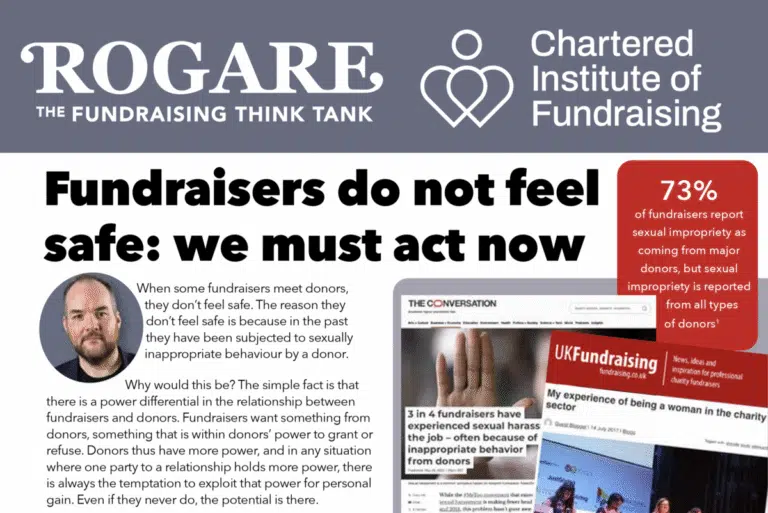
Charities are being urged to create a Donor Code of Conduct in order to protect the fundraisers they employ from donor or supporter behaviour which makes them feel unsafe.
The Chartered Institute of Fundraising together with fundraising think tank Rogare have urged charities across the UK to sign a pledge committing to develop and implement a Donor Code of Conduct that will safeguard fundraisers from inappropriate donor or supporter behaviour.
The move follows a survey of fundraisers which found that more than half of them had reported having experienced behaviour by a donor or supporter that made them feel physically or mentally unsafe.
Advertisement

The 212 anonymous responses highlighted the following:
- 109 (51%) reported having experienced behaviour by a donor that made them feel
physically or mentally unsafe. Ninety-six of these respondents completed further
questions about their experiences. - 76 (36%) said it had never happened to them, but they knew of others it had happened to.
- 27 (13%) said not only had it not happened to them, but they were not aware of others experiencing inappropriate behaviour.
Of the 96 respondents who completed further questions about inappropriate behaviour the report reveals:
- 82 (88%) said they had experienced this behaviour more than once.
- 7 (8%) said they had only experienced this behaviour once but it was enough to
make them feel very unsafe. - 8 (8%) have felt seriously unsafe on more than one occasion.
- 47 (53%) see it as something that happens regularly enough that they have to be
ready for it.
Inappropriate behaviour reported
The main type of inappropriate behaviour reported by fundraisers in the survey was sexually
inappropriate behaviour – including:
- sexual innuendo, banter or unwanted comments
- inappropriate physical contact
- improper propositioning
- and one report of sexual assault.
Who carried out this inappropriate behaviour?
The survey found that the most significant amount of inappropriate behaviour was committed
by major donors and philanthropists or carried out towards major donor and philanthropy
fundraisers.
But it is not limited to those people and situations. Fundraisers also reported it from other types of donors and supporters, including:
- event participants
- friend groups
legacy/bequest donors - and trusts and foundations.
Katie Docherty, chief executive of the Chartered Institute of Fundraising, said: “While this survey represents just a sample of fundraisers operating across the UK, the results from it are simply horrifying and unacceptable.
“Whether it’s one person, or 100 – a report of sexual assault, sexual misconduct or sexually inappropriate behaviour, is one report too many. No one should have to go to their work every day with the fear of this type of behaviour hanging over them.
- Regulator finds Presidents Club in breach of code (13 July 2018)
“And while sexually inappropriate behaviour has been the main problem reported in this survey, it’s not the only one – fundraisers, whether volunteers or staff, have been shouted at and abused for simply doing their jobs and this can no longer continue. That is why the CIOF, with Rogare, is calling on all charities across the UK to sign our pledge, committing to developing and implementing a Donor Code of Conduct for their organisation – fundraisers are the beating hearts of our sector and we need to ensure they are properly safeguarded from these types of behaviours.”
Blueprint to Dismantle Patriarchal Structures in Fundraising
A code of conduct for donor behaviour was one of the recommendations from Rogare’s Blueprint to Dismantle Patriarchal Structures in Fundraising.
Damian Chapman, chair of Rogare, said:
“In this day and age, no one should be going to work worrying that they might be sexually assaulted or constantly having the thought of inappropriate behaviour in the back of their mind.
“Sexual harassment is the most extreme form of donor behaviour that might make fundraisers feel unsafe – but it is not the only one. Bullying both verbal and physical, making disparaging comments about a fundraiser’s protected characteristics, such as their race or sexual orientation, or interfering with their work or career might all harm a fundraiser’s psychological wellbeing.
He added:
“We want charities to pledge to safeguard their fundraisers and volunteers – from those who are working in your major donors team to your field fundraisers who are out knocking on doors or speaking to people in the street, to your events teams who are staffing cheer stations at major events like the London Marathon. While it’s unacceptable that they may experience this behaviour, they should feel confident that they can report any issues and know they will be dealt with properly and efficiently, which is why a Donor Code of Conduct is so important.”
- My experience of being a woman in the fundraising sector (14 July 2017)
Donor Codes of Conduct in use
Donor codes of conduct have been created and implemented by some charities, and take various forms.
Antonia Brownlee, Director of Philanthropy at Scottish Ballet, said:
“We introduced our own Donor Guiding Principles six months ago, after a two-year process that included internal consultation with Board members, consultations with fundraisers and input from dancers, whom the code is also designed to protect.
“We chose to restate the values that Scottish Ballet adheres to – such as anti-racism, and a zero-tolerance approach to discrimination and improper conduct – and invited supporters to join the organisation in living those values.”
These principles are sent to patrons when they first join, asking them to confirm that they have read and acknowledge the code, and are resent when patrons renew their annual support.
Brownlee added:
“Six months on from its introduction, there has not been an incident for which the principles have needed to be invoked. But just having them in place has made Scottish Ballet’s fundraisers feel more confident in dealing with any problems that might arise – having this donor code of conduct has really empowered us to feel confident in starting values-led conversations at the very beginning in discovery meetings with potential donors.”
Photo by Nick Fewings on Unsplash
What might such codes look like?
The Chartered Institute of Fundraising has published two examples of such a code, from the University of Edinburgh and Scottish Ballet.
Rogare has published a sample Donor Code of Conduct which you can download.
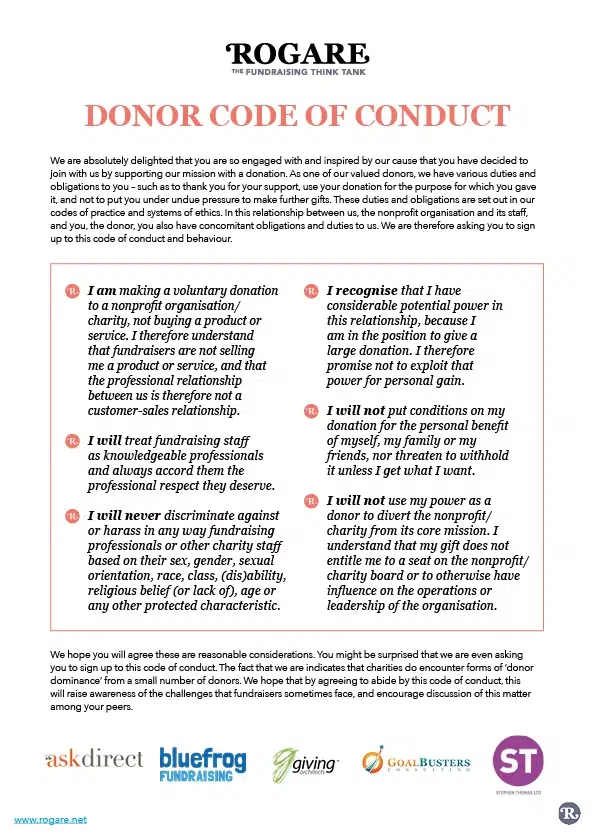
You can find more from Rogare on its Gender issues in fundraising – dismantling the patriarchy section.
FAQs on a donor code of conduct
The CIOF has also published some frequently asked questions on a Donor Code of Conduct, and it also publishes a Safe Environment Hub, explaining how it is working to create a safe environment for fundraisers.
WATCH: Helping fundraisers feel safe through a code of conduct for donors, with Rogare
The CIOF this week hosted a webinar using the Scottish Ballet’s actions as a case study.

- CIOF expels member over sexual harassment complaint and announces new independent review (26 August 2021)
- IOF to set up taskforce to tackle sexual harassment in fundraising (28 March 2019)
- A quarter of female fundraisers experience sexual harassment, says AFP survey (11 April 2018)
- Charities condemn Presidents Club in wake of FT investigation (24 January 2018)
Related posts
IoF shares recent experiences of UK fundraisers at international conference

Fundraisers invited to participate in Rogare research into ‘donor dominance’
Chair of Chartered Institute of Fundraising to step down at AGM
CIOF issues apology as independent review concludes it failed in responses to past allegations of sexual harassment or assault

About Howard Lake
Howard Lake is consultant editor of UK Fundraising. He founded the site in 1994 and successfully sold it in 2022. As director of Giving X Ltd he is exploring growing giving on a massive scale.
He is the founder of Fundraising Camp and co-founder of GoodJobs.