


Donor retention report: pressure drives supporters away

Howard Lake | 21 November 2026 | News

Guilt-heavy and too-frequent asks are the biggest reasons supporters consider walking away from charities, according to a new donor retention report from digital experience agency manifesto. Yet 94% of charity leaders call supporter experience a top priority, and 92% are increasing their investment.
At a glance
- Report: Mind the Engagement Gap 2026, from digital experience agency manifesto, published on 19 November 2026
- Evidence: YouGov survey of 1,626 UK supporters and Censuswide survey of 302 senior staff at charities with income of £10 million or more (September 2026)
- 34% of supporters have considered stopping over guilt-heavy or pushy messages, and 30% over being asked too often
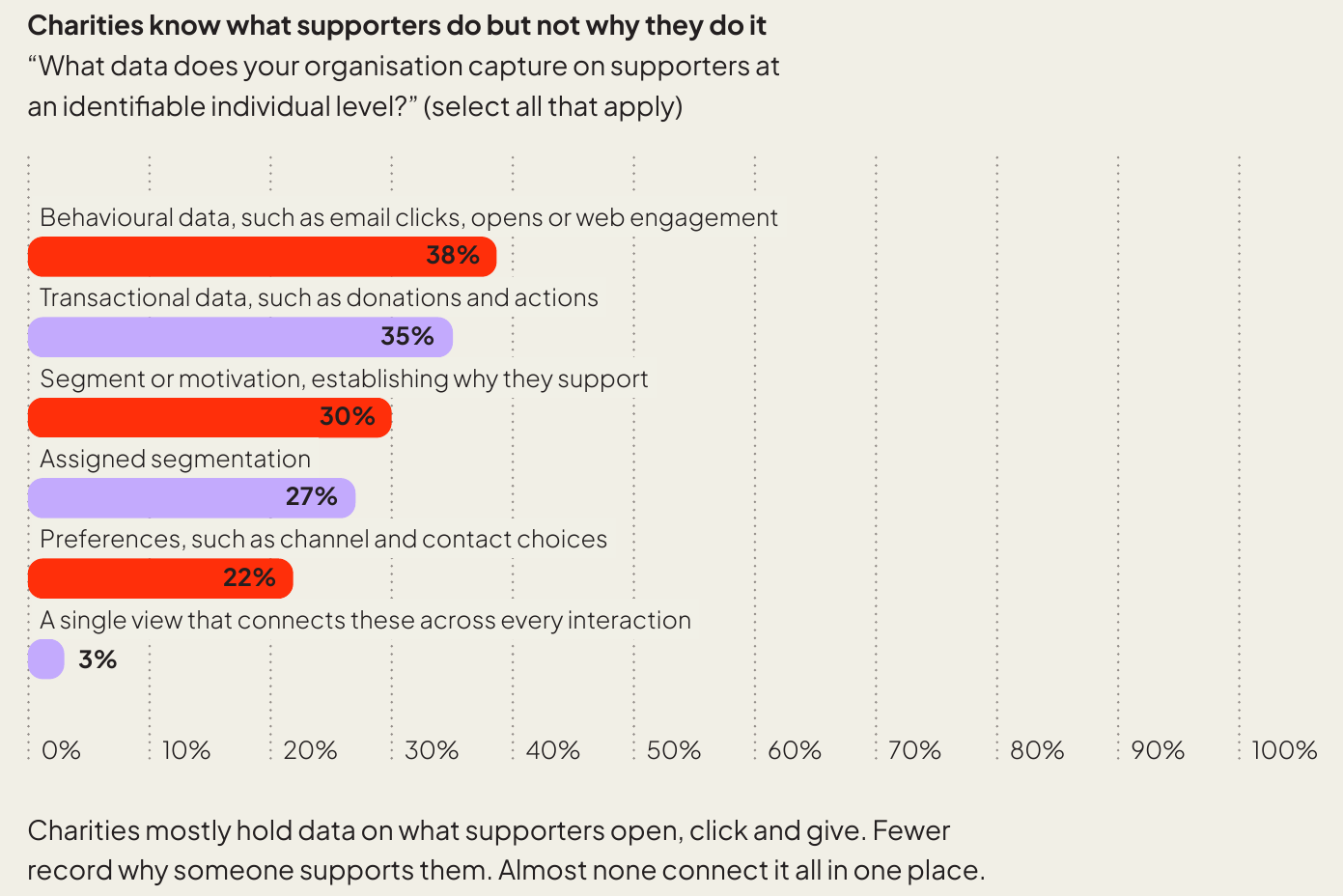
- Only 3% of charities hold a single view of each supporter, and just 22% record individual contact preferences
Why supporters consider walking away
The report follows manifesto’s 2025 study of why donors disengage. Pressure is the most common reason supporters consider stopping: 34% cite guilt-heavy or pushy messages and 30% say they were asked too often. Among lapsed supporters, 35% said they were asked too often, although affordability was the most common reason overall (44%).
Advertisement
A third of supporters (33%) now barely notice (24%) or actively avoid (9%) what charities send. Some 85% are not increasing their giving, including 12% who give less and 6% who have stopped supporting some charities.
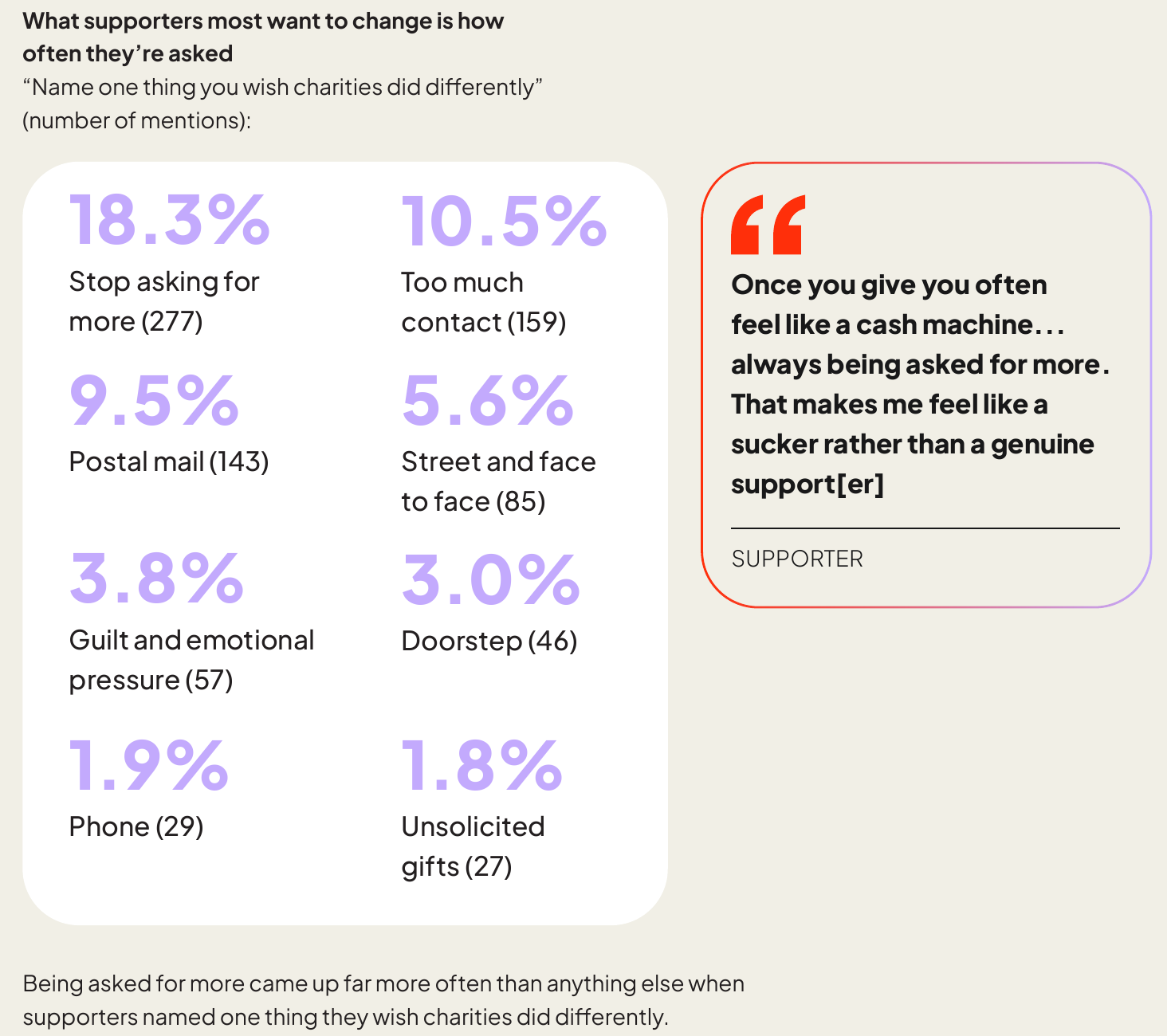
The report sets this against the Charities Aid Foundation’s estimate that giving fell 9% in a year, from £15.4 billion to £14 billion, with six million fewer donors than a decade ago. It also cites Dataro data showing communication volumes up 3.9 times while donor response rates fell by 64%.
Where charities fall short of what supporters want
The table pairs what supporters said with what charity leaders reported.
| Supporter need | What supporters say | What charities report |
|---|---|---|
| Control | 81% rate control over contact as important | 22% hold each supporter’s preferences |
| Respect for timing | 80% rate not being pushed before they are ready as important | 53% say each team focuses on its own targets and KPIs |
| Honesty about impact | 91% rate trust that their support reaches the cause as important; 21% were unsure of their impact | 30% record why each supporter gives |
| Recognition | 63% rate being spoken to like a person as important; 47% felt appreciated after their last gift | 3% hold a single view connecting every interaction |
Silos, tools and ownership behind the gap
Manifesto argues the gap is made backstage. Some 53% of charities say teams focus strictly on their own targets, and only 14% say marketing, fundraising or audience teams lead technology decisions.
While 43% report modern, feature-rich platforms (the report’s “Ferrari in the garage”), just 3% design around the whole supporter journey.
Louise Lai, CEO of manifesto, says supporter experience “can’t be the responsibility of a small team”.
Six places to start
The report says charities need not launch a large transformation programme. It recommends six starting points:
- Audit what supporters actually receive across teams and channels
- Switch on frequency caps and suppression rules, backed by shared contact rules above team targets
- Replace the all-or-nothing opt-in with a preference centre covering post and phone as well as email
- Ask one “golden question” at sign-up about why someone supports you
- Redesign the thank-you to show what a gift achieved before the next ask
- Set shared measures, tracking satisfaction, opt-outs, complaints and attrition alongside income
It suggests starting with one journey, such as first to second gift, and testing newer approaches including AI that decides what each supporter receives next. In one case study, Shelter says one-off donors in its redesigned welcome journey were 50% more likely to give a second gift than its previous benchmark for all cash givers.
What fundraisers should do now
Suggestions from UK Fundraising
- Map every ask a sample of donors received from all teams last month, and look for asks arriving within days of a gift
- Check that frequency caps and suppression rules are on in every sending tool, and who owns the contact rule
- Check whether your thank-you shows what the gift achieved before another ask arrives
How to read the donor retention report
Four of the report’s six case studies (RNIB, Animals Asia, Concern Worldwide and WWF UK) are from Manifesto’s client work. The charity survey covers only organisations with annual income of £10 million or more, and the supporter figures show those who have considered stopping, not those who left.
- Investing in supporter experience grows loyalty & retention, study shows (13 June 2022)
- Research suggests taking new approach to improve retention (3 November 2022)
- What the research says: telephone thanking (31 July 2026)
Related posts

Manifesto report highlights ‘engagement gap’ with donors

Brain study reveals what limits our compassion for large-scale and overseas crises
Donor experience a focus for most but balancing income targets presents challenge, IoF report shows

Fundraisers invited to participate in Rogare research into ‘donor dominance’
About Howard Lake
Howard Lake is consultant editor of UK Fundraising. He founded the site in 1994 and successfully sold it in 2022. As director of Giving X Ltd he is exploring growing giving on a massive scale.
He is the founder of Fundraising Camp and co-founder of GoodJobs.