


Goldman Sachs: ultra-wealthy donors “step up giving”

Howard Lake | 24 November 2026 | News
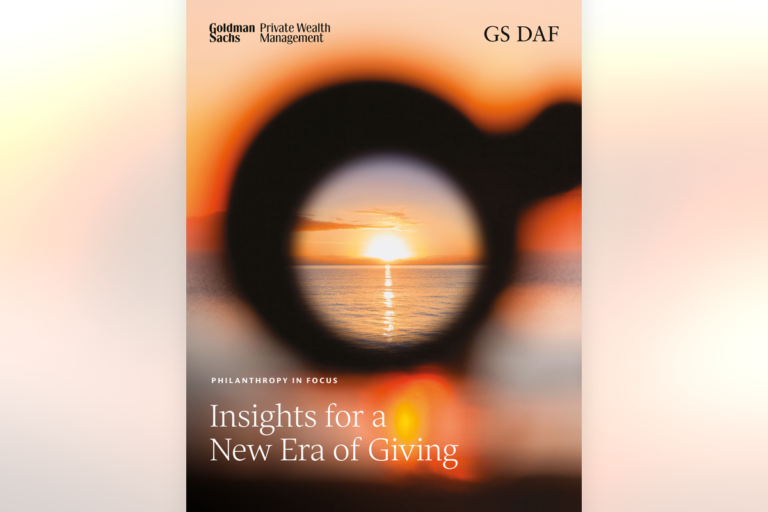
Ultra-wealthy donors in North and South America are stepping up their giving as government funding retreats, according to a new report from Goldman Sachs Private Wealth Management, with 41% of surveyed clients planning to give more over the next three years.
Philanthropy in Focus: Insights for a New Era of Giving is based on an online survey of 569 Goldman Sachs private clients, family businesses and family offices, carried out in June 2026. It argues that high government debt, ageing populations and AI disruption are squeezing public funding at the same time, and that wealthy philanthropists are well placed to respond.
The report is primarily focused on developments in the Americas, with 93% of respondents giving that as their location. It defines an ultra-high-net-worth (UHNW) individuals as one who has assets of more than US$30 million.
Advertisement
41%
of surveyed clients plan to increase their giving over three years (48% of those giving US$1.5 million or more a year). Base: 569 clients
US$250 billion
total global UHNW giving in 2025, almost 32% up on 2022. Altrata data cited by the report, not survey results
44%
below the 10-year average: government humanitarian aid contributions in 2026 (UN OCHA data cited by the report)
12%
of respondents cited the charitable tax deduction as a reason for giving (up to two reasons allowed). 78% chose alignment with their values
Values, not tax breaks, drive giving
Respondents could choose up to two reasons for giving. Alignment with values and beliefs came first at 78%, followed by personal connection, relationship and engagement at 51%. Only 12% cited the charitable tax deduction, and 6% said deductions influence how much they give in a year.
Values mattered more to US donors (80%) than to European ones (57%), according to the report.
| Reason for giving | Share of respondents |
|---|---|
| Alignment with values and beliefs | 78% |
| Personal connection, relationship and engagement | 51% |
| Response to urgent community or global needs | 28% |
| Legacy and intergenerational continuity | 12% |
| Charitable tax deduction benefit | 12% |
Government retreat, donor response
The report cites UN OCHA data showing government humanitarian aid contributions in 2026 are 44% below the 10-year average, and says funding for ‘everyday charities’ in the US has fallen by 38% since January 2025.
On the UK, it cites Charities Aid Foundation research that corporate charitable giving fell by 10% in real terms between 2022 and 2024, with only 23% of UK businesses supporting charities.
Against that backdrop, 45% of respondents say they have adjusted their giving strategy in response to recent geopolitical shifts. Some 30% have increased their giving, 16% have changed the causes they support, 9% are making more multi-year gifts and 7% have become more private about their giving. The other 55% report no change.
More giving, from fewer people
The report describes giving as rising but increasingly concentrated in a smaller number of people. It cites Altrata data putting total global UHNW giving at US$250 billion in 2025, and says the average grant from Goldman Sachs’ own US donor-advised funds rose from US$17,500 in 2016 to US$77,500 in 2025.
Looking ahead, 56% of respondents expect their giving to stay broadly the same, 41% plan to scale up and 3% expect to give less. The share planning to give more reaches 48% among those giving US$1.5 million or more a year, and 61% in Europe, although Europe accounts for only 7% of the sample. Among donors with mature, set strategies, only 21% expect to give more.
Education is the most common focus (56%), ahead of local community (34%), health (24%) and arts and culture (22%).
Most donors are not going it alone: 75% involve family members in their giving, 76% make multi-year commitments or blend them with one-off gifts, and 70% would welcome working more closely with other philanthropists, mostly to share ideas (46%) or attend educational events (42%). Just 22% are interested in co-funding. One in five (20%) already use AI in their giving, mainly for research and due diligence on grantees.
Context for UK fundraisers
UK fundraisers wanting domestic figures can compare UK Fundraising’s coverage of wealthy UK donors giving an estimated £12.4 billion in 2025. The full report is available from Goldman Sachs Private Wealth Management.
What fundraisers should do now
Editorial suggestions from UK Fundraising. The survey is mostly of US donors, so test these against your own supporters.
- Lead with values and relationships, not tax relief. Only 12% cited the tax deduction as a reason for giving. In major donor conversations, ask what the donor wants to change, and why, before explaining any tax benefits.
- Offer multi-year partnerships. Some 76% make multi-year commitments or blend them with one-off gifts. Put a multi-year option in front of your most engaged major donors, with a clear plan for how you will report back on progress.
- Connect donors with each other. Some 70% would welcome working more closely with other philanthropists, mainly to share ideas or attend learning events. Consider a donor briefing or roundtable on your cause instead of another stewardship event.
- Wealthy UK donors gave £12.4 billion in 2025 (16 November 2026)
- Why charities must rethink major donor fundraising in 2026 (31 January 2026)
- Wealth-X index show ultra-rich philanthropy on increase (15 December 2015)

About Howard Lake
Howard Lake is consultant editor of UK Fundraising. He founded the site in 1994 and successfully sold it in 2022. As director of Giving X Ltd he is exploring growing giving on a massive scale.
He is the founder of Fundraising Camp and co-founder of GoodJobs.