


Fundraising tops charity challenges, Cranfield finds

Howard Lake | 12 July 2026 | News

Financial pressure remains the single biggest challenge facing charities, but organisations increasingly want human-led, relational support to help them navigate it, according to new research from Cranfield Trust.
The report, Right support, right time: Insights from across the sector, draws on an online survey conducted between 12 and 30 March 2026. It gathered responses from 209 charities and not-for-profit organisations, 37 funders, 105 volunteers and 17 staff and associates. The research was carried out with nfpResearch, which supported the design and analysis pro bono after Cranfield Trust won its Small Charity Research Award.
Income generation and fundraising emerged as the most frequently ranked challenge across all four stakeholder groups. Around two thirds of funders, charities and volunteers identified it as a top pressure, rising to 94% among Cranfield Trust’s own staff and associates.
Advertisement
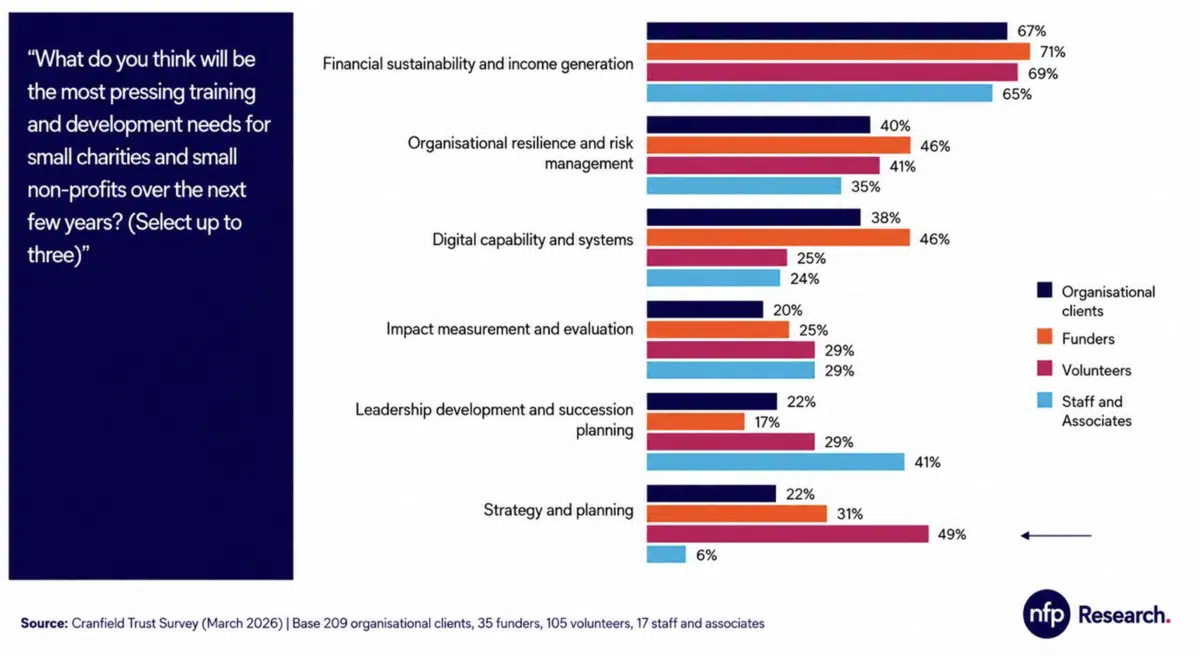
Beyond fundraising, the report found a balanced set of pressures rather than a single dominant concern. Charities most often cited succession planning (25%) and leadership capacity and wellbeing (24%). Funders placed far greater weight on leadership wellbeing, with 46% flagging it compared with 24% of charities, suggesting funders are especially alert to leadership strain and continuity risk. Governance and leadership development were repeatedly identified as important for resilience, yet the analysis suggests both remain underserved.
The value of human judgement in the face of AI tools
A striking theme running through the findings is the enduring value of human judgement in an age of abundant information and AI tools. Across all groups, respondents emphasised relational, human-led support that offers a trusted external perspective and space to think. Charity respondents described this independent view as “fresh eyes” or “a critical friend”, while one-to-one consultancy and mentoring were consistently rated as high impact.
When asked about preferred methods of support, one-to-one consultancy featured in the top three for all four groups. Charities signalled a preference for a broad mix, wanting more short, practical training (47%), one-to-one consultancy (43%), mentoring (41%) and access to trusted online resources (40%). Funders leaned more heavily towards intensive, relationship-based help, most frequently prioritising one-to-one consultancy (57%) and mentoring (57%). The appetite for short, practical training among charities points to time-poor leaders needing support that fits busy roles.
Mentoring and peer support featured prominently as ways to reduce the isolation many charity leaders experience. Several leaders reported that having a trusted person to think alongside gave them the confidence to lead more effectively, reinforcing the link between individual leader resilience and wider organisational strength.
How should support be funded?
The research also surfaced a tension over how support should be funded. Charities most frequently said support should remain free at the point of access (63%), reflecting continued financial constraints. Funders, by contrast, placed greater emphasis on quality and depth of support (40%) and measurable, meaningful impact (40%). Cranfield Trust notes this question related specifically to its own long-standing pro bono model, so the findings may not transfer directly to infrastructure organisations with different funding models.
Cranfield Trust volunteers, meanwhile, showed a strong appetite to contribute beyond their current assignments, and were especially keen for the Trust to act as a knowledge hub sharing what practically works in small charity leadership and management.
In order to ensure that widening access does not come at the expense of quality or sustainability, the report calls for:
- clearer pathways to the right support at the right time
- protection of human connection as technology expands
- and sustained investment in charity infrastructure.
The full report in PDF is available from Cranfield Trust.
- Cranfield Trust launches charity management month to support sector leaders (23 April 2024)
- Project identifies lack of training opportunities for upskilling emerging leaders of smaller charities (1 August 2023)
Related posts
Women missing out on fundraising leadership roles, research shows

“Frustrating & worrying” lack of progress on racial equity at most senior levels, survey shows

Research yields top 10 tips for converting donors to Gift Aid
Beneficiary framing examined in new Rogare paper

About Howard Lake
Howard Lake is consultant editor of UK Fundraising. He founded the site in 1994 and successfully sold it in 2022. As director of Giving X Ltd he is exploring growing giving on a massive scale.
He is the founder of Fundraising Camp and co-founder of GoodJobs.