


Rogare issues warning as commission-based pay for fundraisers is deregulated

Howard Lake | 4 February 2026 | News
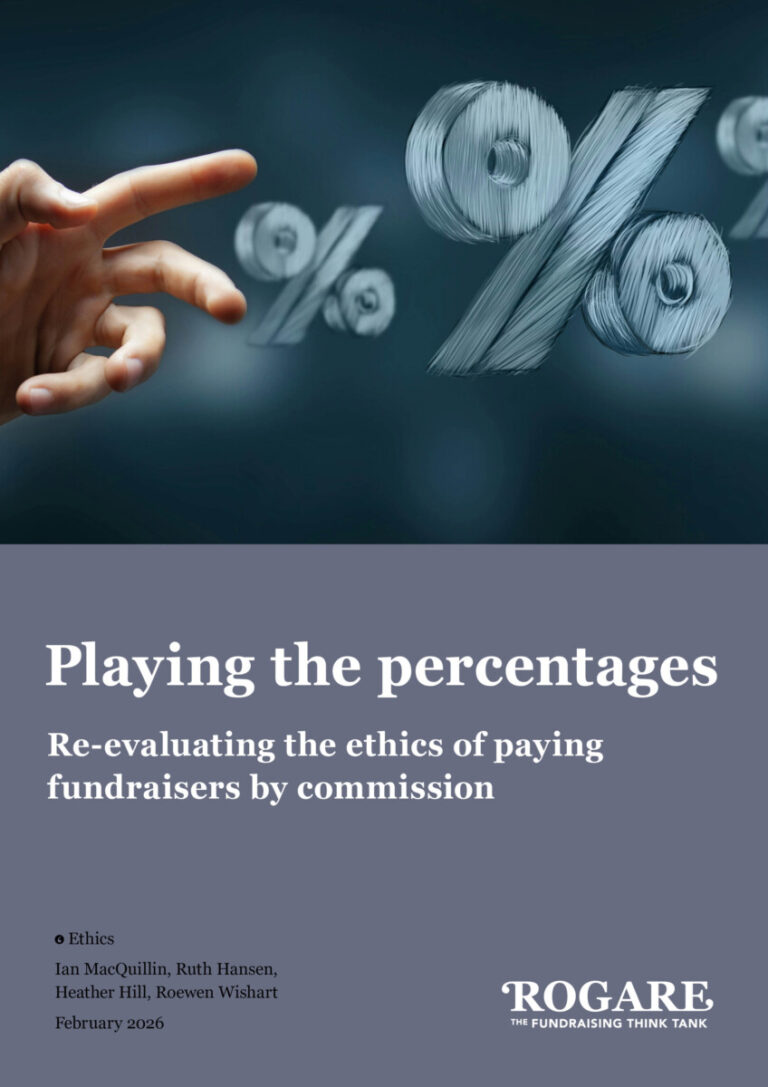
International fundraising think tank Rogare has issued a stark warning to the charity sector: the ethical arguments historically used to oppose commission-based pay are “not up to the job” now that regulatory prohibitions are being stripped away.
In a new green paper titled Playing the percentages: Re-evaluating the ethics of paying fundraisers by commission, Rogare explores the vacuum left by the deregulation of commission-based pay in Australia (2021) and the upcoming changes in the UK (2025). The report suggests that senior fundraising directors and charity leaders can no longer rely on the “shield” of regulatory codes and must instead develop more robust ethical frameworks to protect their organisations and staff.
The regulatory “safety net” is gone
For decades the prohibition on paying fundraisers a percentage of the money they bring in has been a cornerstone of global fundraising standards. However, Rogare’s research suggests the profession has become intellectually “lazy” by relying on these rules.
Advertisement

“Ethical arguments against commission have been the moral icing on the regulatory cake,” the paper notes. “But it is the regulation that has done the heavy lifting.”
With that regulation removed, the burden of proof shifts.
Senior leaders who wish to avoid commission-based models must now defend that choice against two powerful arguments in its favour:
- that it can raise significantly more money for good causes
- and that it allows smaller charities with limited budgets to engage in fundraising they otherwise couldn’t afford.
The topic never disappears. For years it was the most common question and debate that appeared on UK Fundraising’s online discussion forum.
Debunking “weak” ethical arguments
The paper, co-authored by international experts including Ian MacQuillin (UK), Ruth Hansen (USA), Heather Hill (USA), and Roewen Wishart (Australia), critiques 14 traditional arguments against commission. They find many to be “logically flawed” or “unsupported by evidence”.
One common objection is the “windfall gift” scenario, where a fundraiser earns a massive commission on a legacy or unsolicited gift they had nothing to do with. Many charities receive unexpected legacy gifts, large and small, which can not be attributed to any personal connection with the charity, even if charities are able to scour their records for past staff, volunteers, service users. Why line the pockets of an individual who might not even have been born when that life-changing experience occurred and contributed to them deciding to gift that donation on their death?
Rogare argues this is a “straw man” argument; a charity can simply write a contract that excludes such gifts.
Similarly, the paper notes that many leaders engage in “special pleading,” labeling commission as unethical while simultaneously supporting performance-related bonuses, which function in a similar way.
A new moral deterrent: psychological wellbeing
While the report identifies weaknesses in old arguments, it introduces a powerful new one: the duty of care.
The authors argue that the strongest case against commission is the potential harm to a fundraiser’s psychological wellbeing. Evidence from the commercial sector suggests that commission-heavy roles lead to high stress, burnout, and mental health challenges.
“If payment by commission became commonplace, it could fundamentally damage the culture of the profession,” says Ian MacQuillin.
The report suggests that unless a charity can guarantee the mental health of its fundraisers, it has no ethical standing to use commission, regardless of what the Code of Practice says.
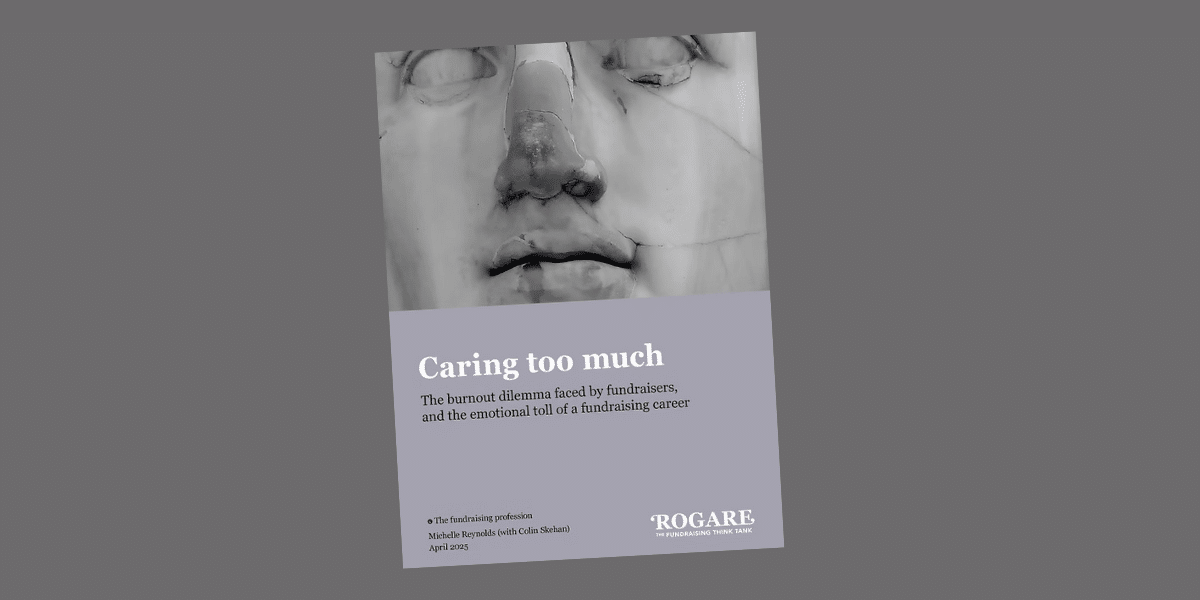
The mental health of fundraisers was the topic of one of Rogare’s publications last year, Caring Too Much.
The 12-point safeguard framework
To navigate this new landscape, Rogare proposes 12 mandatory safeguards. The think tank suggests that commission should never be paid unless these conditions are met:
| Category | Safeguard Requirement |
|---|---|
| Personnel | 1. Contractors Only: Never for internal salaried staff; freelancers/agencies only. |
| 2. Mixed Pay: Never the sole form of pay; must be part of a remuneration mix. | |
| Transparency | 3. Donor Disclosure: Existence of commission pay must be disclosed to donors. |
| 4. Audit Trail: Commission is only due when there is a clear link from ask to gift. | |
| Financial Controls | 5. No Windfalls: Specifically exclude unsolicited or “unexpected” gifts. |
| 6. Capped Payments: All commission payments must have a maximum ceiling. | |
| 7. Time-Limited: Payments must not be open-ended; duration must be fixed. | |
| Governance | 8. Strategic Scope: Boards must define which income streams are eligible. |
| 9. Trustee Approval: The initial decision must be approved by the Trustee Board. | |
| 11. Written Policy: Organizations must maintain a formal, transparent policy. | |
| Risk & Ethics | 10. Risk Assessment: A formal assessment of potential harms must be conducted. |
| 12. Wellbeing: Mandatory safeguards must be in place to protect mental health. |
A radical proposal: permits for commission
In a move that may spark debate among professional bodies, the paper floats the idea of a “permitting scheme”. Under this model, professional institutes (such as the Chartered Institute of Fundraising) could issue permits allowing organisations to pay commission, provided they can prove the 12 safeguards are in place.
While the authors admit this could be overly bureaucratic, they present it as a potential solution for a sector that is no longer protected by blanket bans.
A call for critical fundraising
Heather Hill, co-author of the paper, emphasizes that the goal is not to promote commission, but to force the sector to think more deeply.
“The sector needs to do better than saying ‘because the code says so’ when someone asks why commission-based pay is not permitted,” she says. “This conversation is long overdue.”
As the UK approaches its 2025 regulatory milestone, senior directors are encouraged to review their remuneration policies against these findings to ensure they are ethically sound in a deregulated environment.
The full green paper can be downloaded from Rogare.
Suggested citation: MacQuillin, I.R., Hansen, R.K., Hill, H.R. and Wishart, R. (2026). Playing the percentages: Re-evaluating the ethics of paying fundraisers by commission. Portsmouth: Rogare – The Fundraising Think Tank.
Related posts

Think tank to develop fundraising ethics theory to support the profession
Rogare presents new theory of fundraising ethics
Rogare project examines ethics of legacy fundraising during emergencies

Paper calls for new ethical approach to framing service users in fundraising

About Howard Lake
Howard Lake is consultant editor of UK Fundraising. He founded the site in 1994 and successfully sold it in 2022. As director of Giving X Ltd he is exploring growing giving on a massive scale.
He is the founder of Fundraising Camp and co-founder of GoodJobs.