


Report finds large gaps in NHS charity fundraising

Howard Lake | 17 November 2026 | News
NHS charities in England and Wales raised £410.3 million in donations and legacies in 2024/25, but a new report says many are missing out on millions more, with huge differences in performance between comparable hospital charities.
Flat income, concentrated at the top
The State of NHS Philanthropy 2026, described as the first study of its kind at this scale, analyses three years of published accounts (2022/23 to 2024/25) for 209 NHS charities in England and Wales. It finds that fundraised income is flat in cash terms and falling in real terms, and that income is heavily concentrated. Great Ormond Street Hospital Charity alone raised £114.5 million, 28% of the total, and the 20 largest charities raised £283 million, 69% of the total.
The little growth there has been is at the top. Over the three years the ten largest fundraisers grew their income by 7%, while the other 177 charities that reported in all three years saw theirs fall by 11%. Nearly half of NHS charities raised less in 2024/25 than they did two years earlier.
Advertisement
A 62-fold gap for comparable care
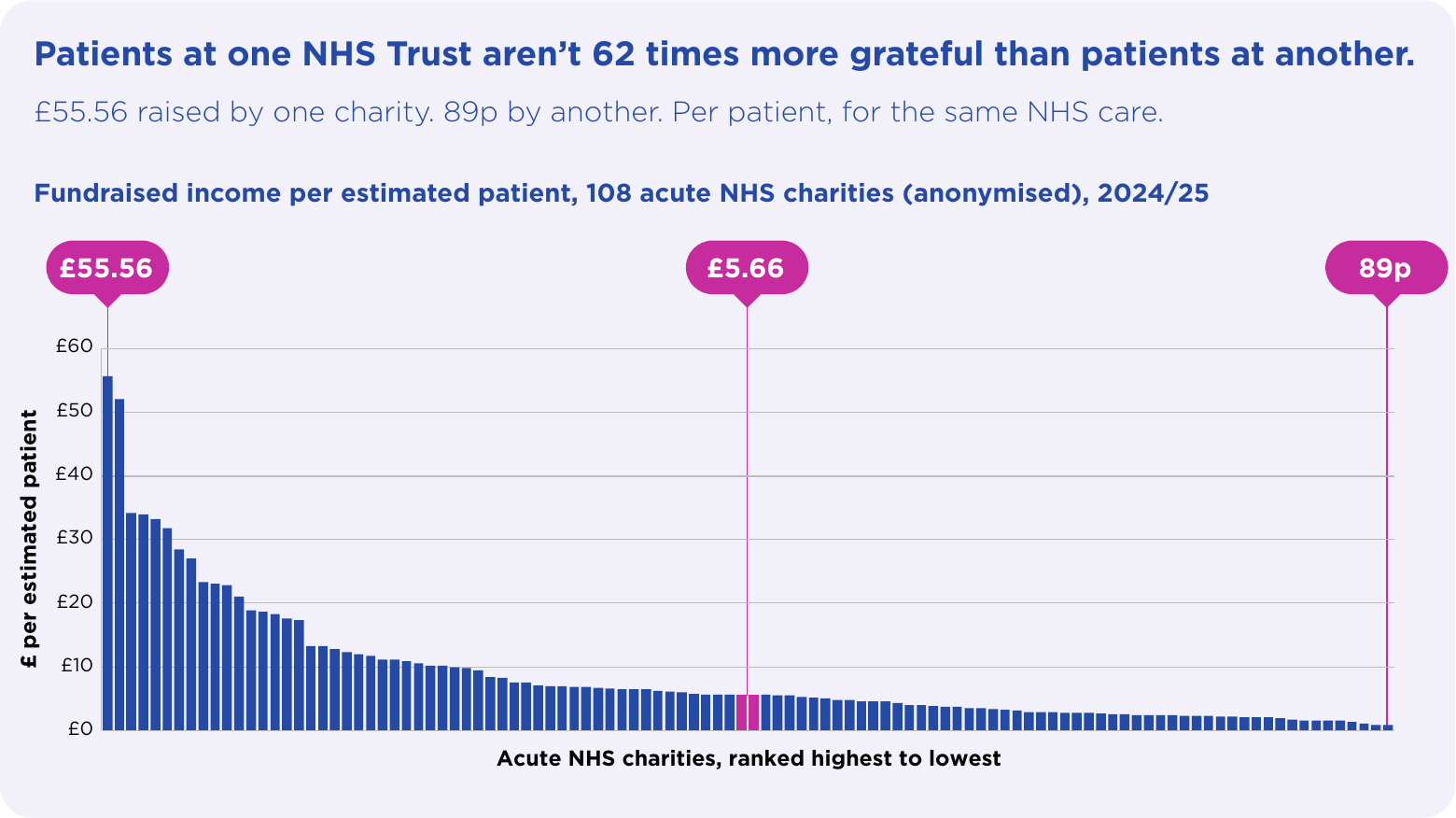
Among 108 acute NHS charities, fundraised income per patient ranges from 89p to £55.56, a 62-fold gap, with a median of £5.66. The report notes that several of the highest figures include capital campaign years, and that per-patient comparisons only make sense between broadly similar organisations.
The gaps are just as wide elsewhere. Among 13 specialist hospital charities the range is £12.38 to £2,448 per patient, nearly 200-fold, and seven of them raise less than £50 per patient. Even the ten charities linked to Shelford Group teaching hospitals, which together raise £58.7 million a year, vary 11-fold. One of them raised 58p for every £100 of its NHS Trust’s turnover in 2024/25 without a major capital campaign. If all ten matched that rate, the group would raise £122 million a year, more than twice today’s total. The report stresses this is an illustration of what is already being achieved within the group, not a forecast or target.
Compare like with like
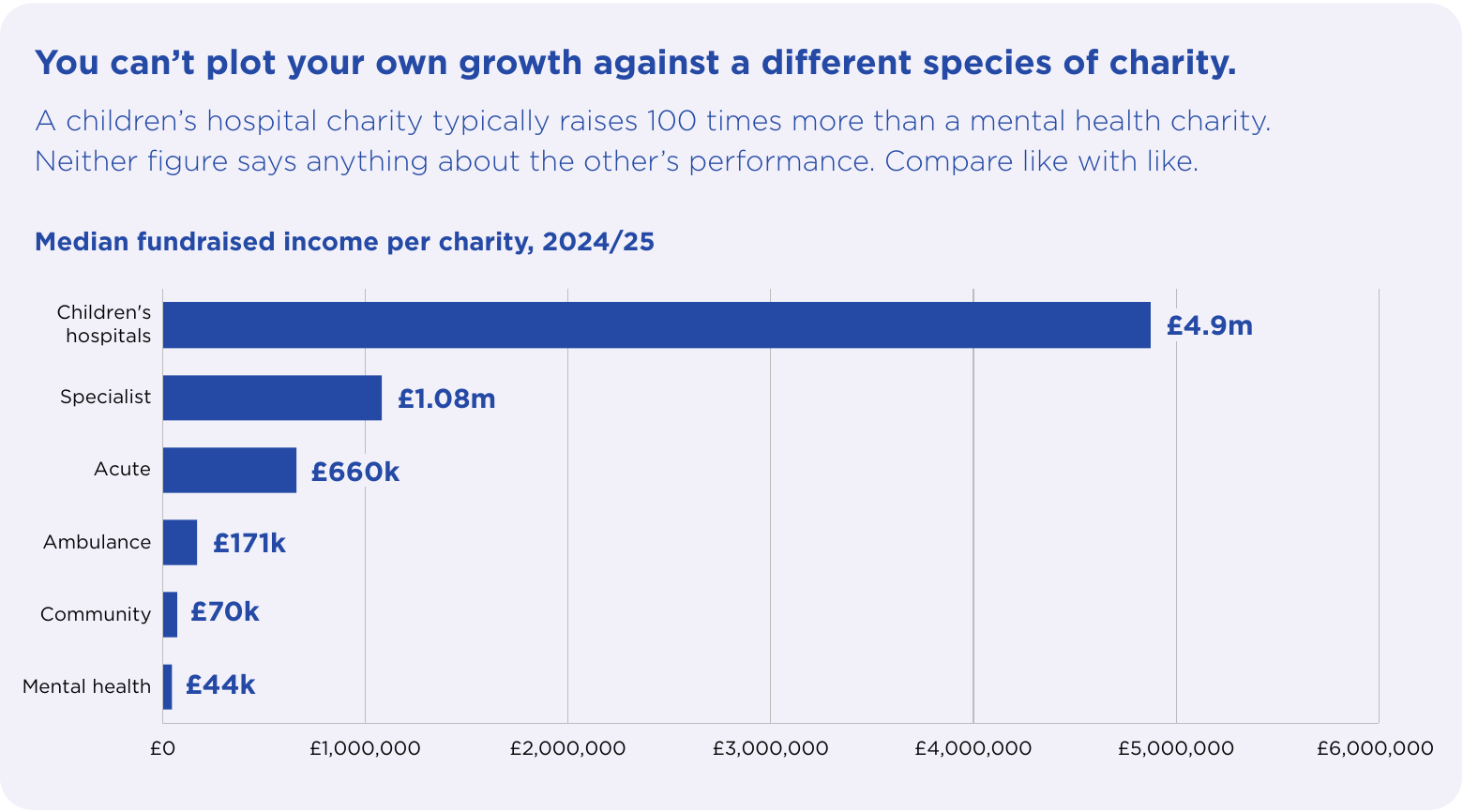
Charity type matters enormously. Median fundraised income in 2024/25 was £4.9 million for children’s hospital charities, £1.08 million for specialist hospitals, £660,000 for acute trusts, £171,000 for ambulance services, £70,000 for community trusts and £44,000 for mental health trusts. The report’s warning for fundraisers benchmarking themselves is not to plot their growth against a different kind of charity.
Investment and governance
Among 106 acute charities with comparable data, those spending more than the typical £1.92 per patient on fundraising raised a median of £9.91 per patient, almost three times the £3.36 raised by those spending less. At the sector median, charities spend 31p to raise every £1. The report is careful to say the data shows an association rather than proof that spending more raises more, since charities already raising more may be able to invest more.
Independent acute charities raised a median £11.60 per patient against £5.15 for those with the NHS Trust board as corporate trustee. Again, the report cautions against concluding that independence alone drives the difference. What matters more, it argues, is trustees and NHS leaders who champion philanthropy and give the charity access to patients and staff, permission to communicate and the ability to invest.
Legacies and the wider health market
Legacies are the biggest single income line for NHS charities: £125 million in 2024/25, almost 30% of the total, though volatile. Fifty-one charities received more than 40% of their fundraised income from legacies in 2024/25, and among charities with three years of comparable data, more than four in ten saw annual legacy income vary fivefold between their best and worst year.
The report says NHS charities receive only around 7p of every £1 left to health causes in UK wills, in a legacy market worth £4.5 billion a year and forecast to reach £10.5 billion by 2050. Its argument is that a legacy programme starts with today’s patient relationships: people cannot remember a charity they never encountered. More broadly, the public gave £2.08 billion to health charities in 2025, with NHS charities capturing under a fifth. The four nations together raised £434.6 million in 2024/25: England £399.0 million, Scotland £19.8 million, Wales £11.3 million and Northern Ireland £4.5 million.
Grateful patient giving: an introduction, not an ask
Report author Gemma Downham, who spent 16 years as an NHS fundraiser, including pioneering the first Grateful Patient Programme for the NHS at Addenbrooke’s, said gifts were being missed because “NHS culture means staff are incredibly humble and nervous about accepting money from grateful patients, who want to give”. In the report she says she has heard of six separate cases in the last six months in which a seven-figure gift nearly failed to reach an NHS charity because the person the donor told did not know how to respond.
Her proposed answer is to treat philanthropy like a clinical referral. Clinicians should never ask for gifts or discuss amounts. They should recognise the cue (“I’d really like to do something to say thank you”), offer to introduce the patient to the charity team, and then step away. Across 134 hospital charities where NHS activity can be matched to fundraising income, an estimated 17.2 million patients were treated in 2024/25. The report’s illustration is that if 1% of them made a single £50 gift, that would raise £8.6 million; at 2%, £17.2 million; at 5%, £43 million. These are not targets or forecasts.
What NHS fundraisers can do now
- Benchmark against true peers. Compare income per patient and fundraising investment with similar charities, not the sector average, and set targets from peer evidence rather than last year’s income plus a percentage.
- Give staff a safe route to respond. Agree a simple, scripted introduction so any member of staff knows who to pass a would-be donor to, and make the charity easy for patients to find.
- Lead with the team, service or research the donor cares about. The report cites programme examples where gifts tied to a specific team or service were up to 15 times larger than gifts to a general fund. This is illustrative rather than benchmark data, and it does not mean creating hundreds of restricted funds.
- Take a wider dashboard to the board. Alongside income, report patient and family engagement, staff introductions, donor retention, major gift and legacy pipelines, and investment.
- Make the investment case. Boards that expect growth, the report says, need to fund the people, data and stewardship that produce it, often before the return arrives.
The report is free to download. Downham Consulting also offers NHS charities a paid, personalised Performance and Growth Review, which includes a board-ready report and a 60-minute leadership debrief.
- New guide helps wealth advisers raise legacy giving (31 August 2026)
- Friends of Moorfields Eye Hospital pledge £1 million to new centre for advancing eye heath (16 July 2024)
- Charities named UK’s “most trusted institution” (7 August 2026)
Related posts
Legacy professionals feel undervalued by non-profit organisations, with lower salaries for women, survey finds
New wealth report highlights potential for Irish charitable sector

More than 1 in 5 charity donors aged 40+ now say they have included a gift in their Will

Charities named UK’s “most trusted institution”
About Howard Lake
Howard Lake is consultant editor of UK Fundraising. He founded the site in 1994 and successfully sold it in 2022. As director of Giving X Ltd he is exploring growing giving on a massive scale.
He is the founder of Fundraising Camp and co-founder of GoodJobs.