


Government advises public to donate cash in civil emergencies

Howard Lake | 23 October 2026 | News
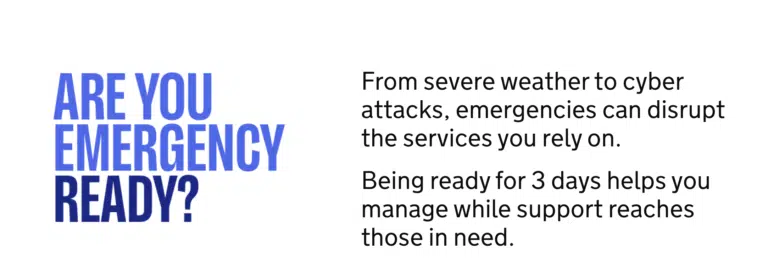
The UK government’s new Be Ready campaign includes advice for people who want to help in a civil emergency. For donors the message is simple: give money through reputable organisations rather than turning up with goods.
The guidance appears in the campaign’s “Play your part in your community” section, alongside advice on volunteering and for community groups. The wider campaign asks households to be ready for three days with water, food, a torch, a radio and other supplies while support reaches those most in need.
Advice tailored to people living in Scotland or Northern Ireland is available from Ready Scotland and NI Direct websites.
Advertisement

What the giving advice says
Donated money, the government says, gives people affected by an emergency “dignity in choice” and helps put money back into the local economy. People should look out for community appeals rather than arriving at community centres or emergency response points with donations.
For local emergencies, it points to the local council or a trusted local charity, and to the charity register to check a name and registration number. Most charities with an income of £5,000 or more must be registered, it notes. UK Community Foundations are named as fast-acting local intermediaries.
For national emergencies it directs donors to the National Emergencies Trust (NET), described as an independent charity offering one trusted place to give. For overseas disasters it names the Disasters Emergency Committee (DEC), and warns that sending physical goods abroad brings customs, storage and transport costs.
Businesses are told that money through trusted charities is still the best help, but that they can offer specialist equipment, skills, goods, logistics or warehouse space after contacting the local council or Local Resilience Forum.
Volunteering
Volunteers are told not to turn up at the scene of an emergency, or travel to help in another part of the country, but to wait for calls for support from councils, community groups or national voluntary organisations.
A directory lists the British Red Cross, St John Ambulance, REACT, the RNLI, NCVO’s volunteering centres and NAVCA members, and encourages people to join a local group beforehand.
Precedents
The donating cash wording is not new: near-identical text appears on the Prepare website the government launched in May 2024.
The Charity Commission often issues “safer giving” advice around major appeals, though mostly for overseas crises. With the Fundraising Regulator it published advice alongside DEC appeals for the Middle East in October 2024 and the Myanmar earthquake in 2025, urging checks on the charity register and the Fundraising Badge. After Russia’s further invasion of Ukraine in 2022 it reminded trustees about moving funds safely, checking disaster recovery plans and watching for cyber attacks. In the early 2010s, after the Haiti earthquake and Japanese tsunami, it issued disaster appeals guidance developed with the DEC.
Other Commission or government advice to the public on giving or volunteering ahead of a domestic civil emergency include the 2004 Preparing for Emergencies leaflet, posted to 25 million homes at a cost of about £8.3 million, and gov.uk guidance on how voluntary organisations can help, which is aimed at the sector rather than donors.
Y2K is a similar case. Action 2000’s booklet to 26 million households in late 1999 was about reassurance and discouraging hoarding, and neither the Charity Commission nor Government asked the public to be prepared to donate or volunteer.
Nevertheless this advice comes at a different time, and suggests preparation for a nationwide emergency. It seems to go beyond focusing on regional or local challenges such as flooding or plane crashes to national emergencies such as (hybrid) war, state-sponsored terrorism, cyber attacks, pandemics (natural or otherwise), extreme weather and damage to infrastructure such as power, data and food delivery.
It comes in the week that the Government took 32 of its websites offline in response to the discovery of a major security vulnerability in the PHP programming language used by millions of websites around the world.
Specifying a role for charities and inviting the public to support them with cash and volunteering is certainly a new or very recent development.
Defence Secretary Wes Streeting spoke about the Be Ready campaign launch while visiting a new tank gun barrel factory in Telford owned by the German manufacturer Rheinmetall.
Other countries’ approaches
Sweden’s “In case of crisis or war” brochure, sent to every household, tells residents to join a voluntary defence organisation, notes the role of other non-profits and faith communities, and asks people to donate blood.
Finland’s guidance describes organisations as a channel through which people can help, naming the Finnish Red Cross among others. Norwegian researchers examined in 2024 how voluntary organisations fit its total defence system. These focus on volunteering but did not mention donating.
What if digital payments fail?
Be Ready’s checklist tells households to keep a mix of coins and notes “in case electronic payments or ATMs are disrupted”. That is common abroad. According to an RTÉ analysis, Sweden advised a week’s purchases in cash, Austria’s central bank €100 per household member and the Bank of Finland 72 hours’ worth, while the Commons Treasury Committee urged HM Treasury in July 2025 to consider recommending it.
Whether people in the UK who act on that advice will feel they can spare some cash for charities from that modest amount is not clear.
Charities have spent years moving from cash to contactless, so an outage raises practical questions. Perhaps not surprisingly, no published UK guidance specifically for charities.
In the absence of formal advice, fundraisers might test:
- whether tins, buckets and collection permissions are still in place, as cash collections fall under the Code of Fundraising Practice
- how contactless devices behave with no connection (some store donations offline for later upload)
- how cash would be stored, counted and banked if branches and ATMs were disrupted
- insurance limits, and safety for volunteers handling cash
- how charities’ online appeals would work without online payments
- how they might emphasise the reminder to donors not to dump inappropriate physical donations outside charity shops, and indeed not to donate low-quality items at all
How charities are responding
NET launched Ready Together, a free toolkit to help communities prepare for and respond to emergencies, on 6 October in Ilminster, Somerset, with its patron the Prince of Wales and ambassador Ross Kemp. A Kensington Palace spokesman said it aims to turn public goodwill into practical preparedness.
The British Red Cross earlier called a planned government campaign a welcome first step in evidence to Parliament, and in July 2025 welcomed the Resilience Action Plan’s recognition of the voluntary sector.
The Department for Culture, Media and Sport sought a partner for a £2.5 million Civil Society Resilience Infrastructure Fund, running October 2026 to March 2029 in England, choosing the British Red Cross. This aims specifically “to better integrate the perspectives and participation of civil society organisations in national and local emergency planning and response activity”.
DCMS also gave the Voluntary and Community Sector Emergencies Partnership (VCSEP) up to £3.1 million from 2022 to 2026.
Voluntary and Community Sector Emergencies Partnership
VCSEP aims “to build capability across the civil society sector to prepare, respond and recover from emergencies. It is a partnership of voluntary and community sector organisations co-chaired by the British Red Cross and the National Association for Voluntary and Community Action (NAVCA)”.
It was created in 2018 following “the Grenfell Tower fire, 2017 terror attacks, and rural flooding across the country”.
Earlier this month it hosted its first all-partner, in-person event, EP:LIVE. This brought together 150 people from across the Partnership in one room “to connect, share experiences, learn from one another and celebrate the power of partnership”.


About Howard Lake
Howard Lake is consultant editor of UK Fundraising. He founded the site in 1994 and successfully sold it in 2022. As director of Giving X Ltd he is exploring growing giving on a massive scale.
He is the founder of Fundraising Camp and co-founder of GoodJobs.