

![[ad] Fundraising Everywhere Trusts and Major Donors Conference December 2026](https://wfay6x.infiniteuploads.cloud/2026/09/fundraising-everywhere-trusts-conference-202612-728x90-1.jpg)
New fundraising app raises donations each time air ambulance charity gets emergency callout

Melanie May | 24 July 2024 | News
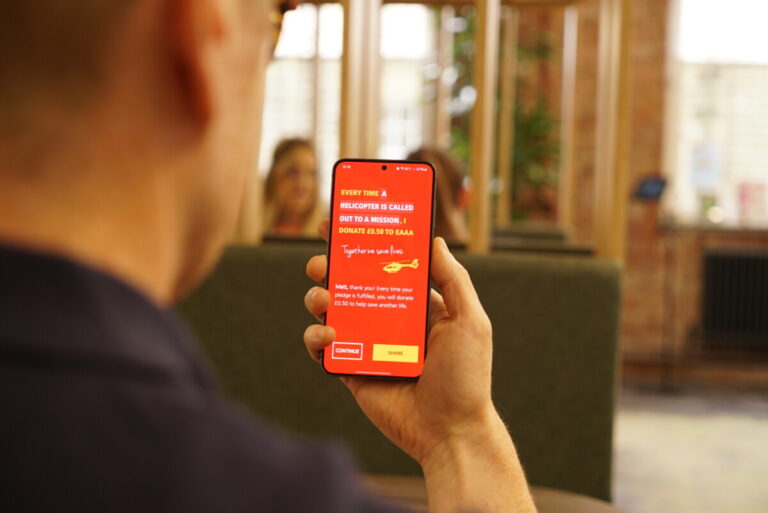
A fundraising app has launched that enables supporters of East Anglian Air Ambulance (EAAA) to give a micro-donation each time a helicopter takes off or a rapid response vehicle is deployed.
The app has been developed by a technology business, building on research by computer scientists at Lancaster University. Launched by EAAA and Lancaster University spin-out company ’If Give Limited’, EAAA Missions uses the charity’s real-time mission data which records every time an EAAA crew is sent out to provide urgent care to people experiencing life-threatening situations. This includes cardiac arrests, medical emergencies and road traffic collisions.
The If Give team’s data capturing algorithms turn each mission into an opportunity for donors to make automatic micro-donations through the EAAA Missions app, starting from 10p, each time EAAA’s crew are tasked by air or road.
Advertisement

Donors will also be able to see a brief summary about the type of call out they have supported, such as its date, time, approximate location and which vehicle and crew responded.
Simon Judd, Head of Individual Giving and Supporter Engagement at East Anglian Air Ambulance, said:
”With ‘EAAA Missions,’ donors can become members of our life-saving crew. Their contributions, no matter how small, have a significant impact on our ability to save lives.”


Ludwig Trotter, Founder of If Give and a PhD researcher at Lancaster University, commented:
“In today’s changing consumer landscape, brands and services focus on technology to offer personalisation, convenience and responsiveness. Today’s charitable donors expect the same level of personalised service and responsiveness and seek meaningful connections and tangible impact from the causes they support.
“Forward-thinking charities like EAAA are looking to revolutionise their approach towards regular donations and deliver experiences that are more tailored to individuals. Our app transforms raw operational data into compelling narratives.
“People can tailor their donations to supporting particular types of emergency rescue missions, or even when teams located at specific bases are in action, which helps to build a new level of engagement between supporters and the charity.
“Through our approach of “If this happens, I will donate”, literally anything can become a trigger for meaningful change.”
Professor Nigel Davies, Head of Lancaster University’s School of Computing and Communications, and Co-Founder at If Give Limited, commented:
“In a world where everything is becoming more automated, and digitalisation becomes widespread, lies a huge untapped potential for charities. EAAA Missions marks a pivotal moment in the evolution of digital fundraising.
“By harnessing the power of data, we are empowering supporters to make a tangible impact on causes they care about, like never before.”
The EAAA Missions app has also been shortlisted in the upcoming Third Sector awards in the Digital Innovation of the Year category.
The Lancaster University research behind the technology was supported through the UKRI Engineering and Physical Sciences Research Council (EPSRC) Impact Accelerator Account and the If Give opportunity has been supported by Innovate UK’s ICURe (Innovation to Commercialisation of University Research).
- Nearly half of UK consumers now familiar with micro-donations (17 October 2024)
- Microdonations – more than just pocket money? (17 September 2010)
- Council's payslip pennies pass the £100,000 mark (14 December 2010)


About Melanie May
Melanie May is a journalist and copywriter specialising in writing both for and about the charity and marketing services sectors since 2001. She can be reached via thepurplepim.com.