


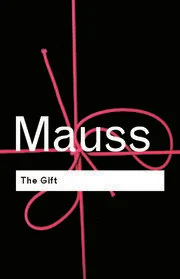
The Gift: The Form and Reason for Exchange in Archaic Societies
Why do we give? And why does a gift given always seem to demand something in return? First published in French in 1925, Marcel Mauss’s short masterpiece is the foundational text for understanding gift exchange, and one of the most influential works in the social sciences of the twentieth century. For anyone working in fundraising or philanthropy, it reaches to the very roots of what giving means.
In 1925, the French sociologist and anthropologist Marcel Mauss published a short essay, little more than a hundred pages, that changed the way the social sciences think about exchange, obligation, and human society. The Gift begins with a deceptively simple observation: in archaic societies across the world, from the potlatch ceremonies of the Pacific Northwest to the kula ring of Melanesia, gifts are never truly free.
The act of giving creates an obligation to receive, and an obligation to give in return. Failure to reciprocate brings shame; generosity beyond what can be matched brings a different kind of power.
From this observation, Mauss draws conclusions that reach far beyond anthropology. If no gift is truly free, if giving always creates a web of obligation, relationship, and social meaning, then what does this tell us about the nature of charity? About the relationship between donor and recipient? About the very concept of altruism?
These questions run through the entire subsequent literature on philanthropy, and the reason is Mauss: his thinking haunts the footnotes of Titmuss’s The Gift Relationship, shapes debates about reciprocity in fundraising, and underlies every serious attempt to think about why people give and what happens when they do.
The Routledge Classics edition, translated by W.D. Halls with a foreword by Mary Douglas, is the standard English text. It remains continuously in print, continuously cited, and continuously generative — a book that repays reading and re-reading at every stage of a career in fundraising, philanthropy, or civil society.
About Marcel Mauss
Marcel Mauss (1872–1950) was a French sociologist and anthropologist, the nephew and intellectual heir of Émile Durkheim. As well as being a pioneering academic, he was a committed democratic socialist and a co-founder of the cooperative newspaper L’Humanité. The Gift is his most famous work, and the one whose influence has proved deepest and most lasting across the social sciences. The foreword to this edition is by Dame Mary Douglas, one of Britain’s most celebrated social anthropologists.
Reviews
“The Gift is quite undeniably the masterwork of Marcel Mauss, his most justly famous writing, and the work whose influence has been the deepest.”
Claude Lévi-Strauss
“The teaching of Marcel Mauss was one to which few can be compared. No acknowledgment of him can be proportionate to our debt.”
Claude Lévi-Strauss
“Few have managed to read it without feeling the whole gamut of the emotions — the pounding heart, the throbbing head, the mind flooded with the imperious, though not yet definable, certainty of being present at a decisive event in the evolution of science.”
Claude Lévi-Strauss
Buy link: https://www.amazon.co.uk/gp/product/0415267498?tag=219
Cover image: https://www.routledge.com/The-Gift-The-Form-and-Reason-for-Exchange-in-Archaic-Societies/Mauss/p/book/9780415267496
Buy on Bookshop.org Buy on Amazon 