


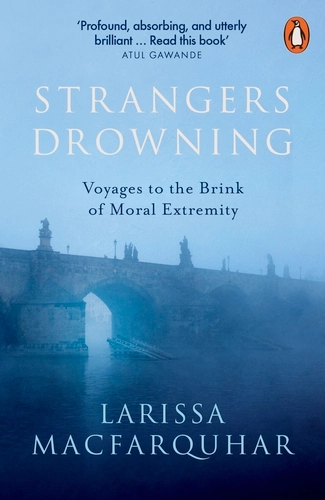
Strangers Drowning: Voyages to the Brink of Moral Extremity
There are those of us who help — and those who live to help. Larissa MacFarquhar’s extraordinary book explores the lives of people who have given everything in the service of others, and asks what their example reveals about the rest of us: about what we owe strangers, what we owe ourselves, and how much is ever really enough.
In Strangers Drowning, New Yorker journalist Larissa MacFarquhar digs deep into the psychological roots and existential dilemmas motivating those rare individuals living lives of extreme ethical commitment. The donor who offers up her kidney to a complete stranger. The activist who abandons his possessions to devote himself entirely to his cause. The couple who adopt twenty children with support needs. Such people inspire us, but they also unsettle us, and force us to question deep-seated notions about what it means to be human.
How could these do-gooders value strangers as much as their own loved ones? What does it really take to live a life of extreme virtue? And might it mean making choices as heartbreaking as the one in the old philosophy problem: abandoning a single family member so that two strangers might live?
Intimate stories
MacFarquhar seeks out these people and tells their deeply intimate stories — their stubborn integrity and their compromises; their bravery and their recklessness; their joys and defeats and wrenching dilemmas. Between their portraits, she threads a lively history of the literature, philosophy, social science, and self-help that have contributed to our deep cultural suspicion of do-gooders in Western society. Why do moral people make us uneasy? And why, when we call people do-gooders, is there scepticism in it, even hostility?
Through its sympathetic and beautifully vivid storytelling, Strangers Drowning confronts us with fundamental questions about what it means to be human. In a world of strangers drowning in need, how much should we help, and how much can we? The book is essential reading for anyone in fundraising, philanthropy, or the charity sector who wants to think more deeply about the psychology of giving, the ethics of altruism, and the moral demands that the existence of suffering places on us all.
About Larissa MacFarquhar
Larissa MacFarquhar has been a staff writer at The New Yorker since 1998. Her profile subjects have included Barack Obama, Noam Chomsky, Hilary Mantel, Derek Parfit, and Aaron Swartz, among many others. Before joining the magazine she was a senior editor at Lingua Franca and an advisory editor at The Paris Review, and has written for Artforum, The Nation, The New Republic, the Times Book Review, and Slate. She has received two Front Page Awards from the Newswomen’s Club of New York.
Reviews
“Daringly conceived, brilliantly executed — may change not just how you see the world, but how you live in it.”
Katherine Boo, author of Behind the Beautiful Forevers
“Chilling and utterly absorbing. Combining critical analysis with compassion, the book’s treatment is reminiscent of Oliver Sacks, who explored the more extraordinary aspects of ordinary lives.”
Frances Wilson, Daily Telegraph
“A brilliant and rigorous thinker. As a book on altruism, this is also a book that invites us to think about selfishness — she’s good on Adam Smith and Darwin, among many others.”
Evening Standard
“Easily the best book on both prescriptive and applied ethics I’ve read in a decade — mandatory reading for the examined life.”
Mary Karr, author of Lit and The Liars’ Club
“A beautiful writer. Strangers Drowning is a beautiful, unique book, full of astonishing and sometimes wild tales of extraordinary altruism. MacFarquhar avoids sentimentality or simple lessons. She shows; she doesn’t tell. Prepare for prose that’s often like poetry — and for some remarkable portraits of the human spirit.”
Cass R. Sunstein, Robert Walmsley University Professor, Harvard University; co-author of Nudge
Buy on Bookshop.org Buy on Amazon“Strangers Drowning is a book written in a deceptively simple and clear voice about people, about how morality lodges itself in a person not as an abstract idea, or even a value, but as a direction for life. Impressive.”
Financial Times
