


Four in ten fundraisers “plan to leave employers”

Howard Lake | 6 November 2026 | News
Almost four in ten fundraisers (39.7%) in major fundraising countries intend to leave their current employer within the next two years, according to new international research from the Institute for Sustainable Philanthropy (IFSP).
More worrying for the profession, 16.2% expect to leave fundraising or development altogether, up from 9% when the Institute last measured this in 2022.
The Heart of Fundraising: The Impact of Wellbeing and Love on Fundraiser Retention, by Adrian Sargeant, James Barrett and Kathryn Edworthy, draws on a survey of 272 fundraisers in Australia, the UK, USA, New Zealand, Canada and elsewhere. Respondents averaged 16 years experience of working in fundraising.
Advertisement

The authors conclude that retention is driven less by salary than by purpose, professional respect and human connection.
A mixed picture on turnover
The proportion of those planning to change employer is lower than the 46% recorded in the Institute’s 2022 international study, which the report calls a marginal improvement, though it describes none of the figures as encouraging. The rise in those planning to leave the field is the more alarming warning.
The report also revisits the cost of churn. It cites US estimates (from 2006 and 2013) that replacing a fundraiser costs 117% of their annual salary, with some commentators putting it as high as 250%, and research suggesting that around a quarter of donors give less, give later or stop giving when their relationship with a gift officer ends.
The authors add that it can take 12 to 18 months to rebuild trust and close major gifts from a leaver’s portfolio.
What motivates fundraisers, and what drains them
Respondents rated motivating factors on a seven-point scale. Making a difference to the cause scored highest (6.3), followed by autonomy, positive team relationships and feeling valued (all 6.2). Being trusted by senior management or the Board, being respected as a professional and good donor relationships each scored 6.1. Salary and benefits scored 5.0, joint lowest alongside regular feedback.
Only 3.3% said salary or benefits had drawn them into fundraising, while 51.8% said they had simply fallen into the role.
The most common draining experiences were unrealistic expectations from senior management or the Board, and a focus on short-term metrics only (both 4.1). Feeling undervalued (3.8), a professional voice not being heard (3.6) and a lack of training and development (3.6) followed.
The authors note that five of the six highest-scoring drains relate to competence, suggesting many fundraisers still work where the nature of fundraising is poorly understood.
Open comments bore this out. Respondents asked for more trust in strategic decisions, fewer approval layers, a CEO or Board that understands fundraising, and proper performance reviews. One said they had hit a glass ceiling because every senior fundraising post at their large charity was based in London.
Career paths: moving on to move up
Career development shows the strongest link to retention, and the weakest provision. Only 16.5% said adequate development opportunities were available to them, with 40.8% reporting some, 33.5% few and 9.2% none. Just 11.7% could clearly see a career path in their organisation, and a further 34.9% could see one somewhat. By contrast, 77.9% said their line manager supported their professional growth strongly or somewhat.
In the statistical modelling, which controlled for age, gender and length of service, respondents who reported a career path (clearly or somewhat) had 82.1% lower odds of intending to leave their employer than those who reported little or none. Those reporting management support for professional growth had 75.2% lower odds. Feeling appreciated was associated with 52.5% lower odds of planning to leave an employer, while feeling undervalued was associated with 92.3% higher odds of planning to leave fundraising altogether.
Sargeant said: “One of the striking findings is that many fundraisers appear to believe they have to move on in order to move up. If organisations want to retain talent, they need to plan for their future whether that be with the current employer or not.”
Love, connection and leadership

The study also asked an unusual question: what does love have to do with fundraising? Some 55.5% of respondents could identify a moment when they fell in love with the profession, often when they saw the impact of their work, created a meaningful experience for a donor, or came to see fundraising as part of their professional identity. Around 3% were uncomfortable with the language of love or had never experienced it in their role.
Donors were the most widely cited source of love at work, followed by line managers and executive leadership. Beneficiaries, fundraising colleagues and other teams also featured, and the report says appreciation from colleagues outside fundraising was uniquely powerful because of the esteem in which service teams are held. The authors stress that organisations cannot manufacture such moments, but can build cultures in which they are more likely.
The authors identify three wellbeing needs, connection, competence and autonomy, and note that meeting them does not require organisations to spend more.
Their recommendations for leaders include respecting fundraising expertise and giving fundraisers a voice, building appreciation into everyday culture, providing genuine career paths, and reducing unrealistic expectations and short-termism. Barrett said fundraisers need to feel professional respect and to be supported by their leadership and Board.
Reading the findings in context
Some context is worth bearing in mind. The survey was promoted through the Institute’s social media and its sponsor F&P, which supported the Australian portion of the work. Of the 272 responses, 143 came from Australia and 58 from the UK, so the findings are not specific to UK fundraisers. Some 83.5% of respondents were female and about two-thirds were directors or managers. Intentions to leave are also not the same as actual departures.
For fundraising leaders, the practical questions are straightforward. Do your fundraisers know what their next step looks like here? Are the expectations set by your Board realistic, and judged on more than short-term metrics? And do those who raise the money hear, regularly and specifically, that their expertise is valued?
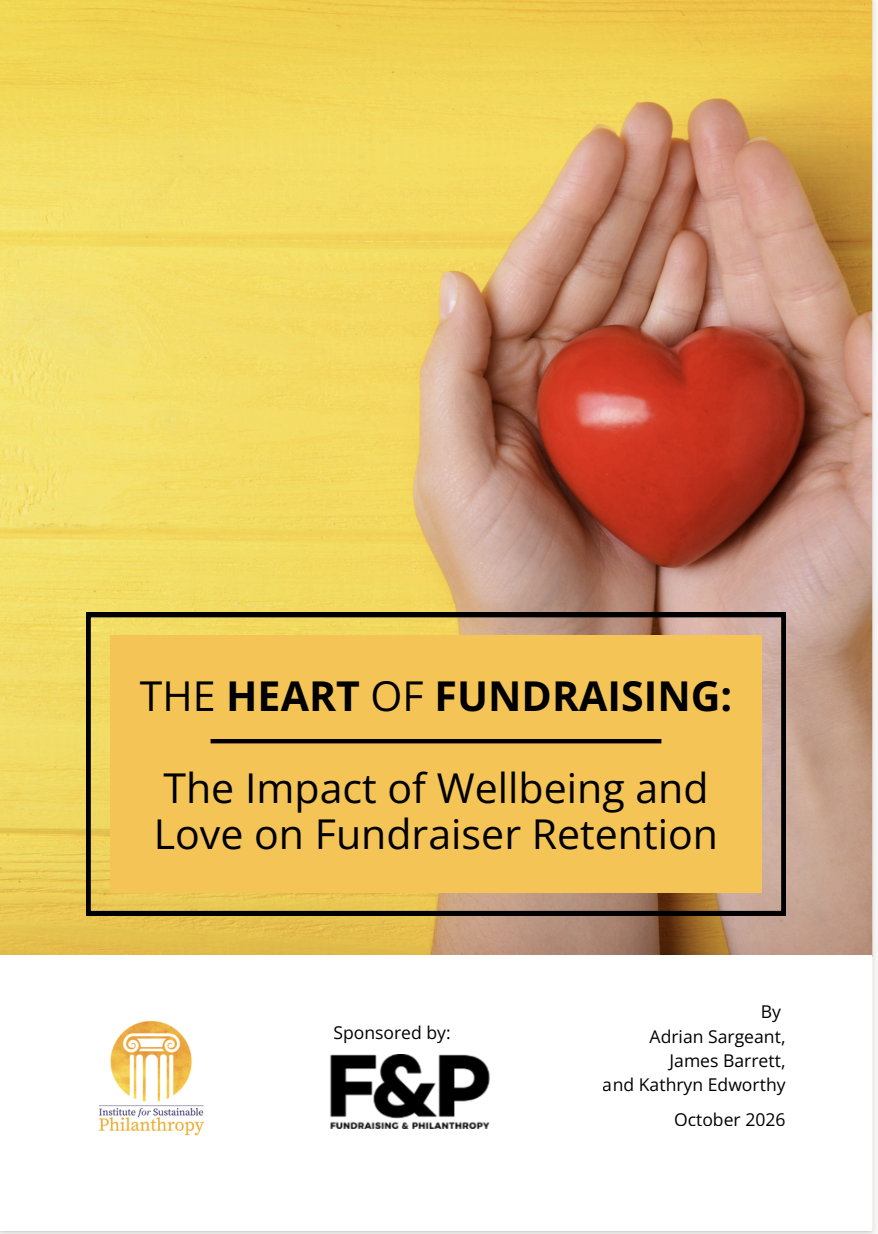
The report is available from the Institute for Sustainable Philanthropy website.
- Research reveals what makes fundraisers tick (27 October 2022)
- Research suggests taking new approach to improve retention (3 November 2022)
- Rogare report explores why fundraisers change jobs and how to retain them (28 August 2025)
Related posts
Adrian Sargeant to lead philanthropic psychology research centre at Plymouth University
Wildlife Trusts’ 30 Days Wild challenge increases happiness, study shows
Women missing out on fundraising leadership roles, research shows

Sector sick leave days on the rise, analysis suggests

About Howard Lake
Howard Lake is consultant editor of UK Fundraising. He founded the site in 1994 and successfully sold it in 2022. As director of Giving X Ltd he is exploring growing giving on a massive scale.
He is the founder of Fundraising Camp and co-founder of GoodJobs.