

![[ad] Fundraising Everywhere Trusts and Major Donors Conference December 2026](https://wfay6x.infiniteuploads.cloud/2026/09/fundraising-everywhere-trusts-conference-202612-728x90-1.jpg)
Rogare asks if English-speaking fundraising ideas crowd out local fundraising

Howard Lake | 8 October 2026 | News
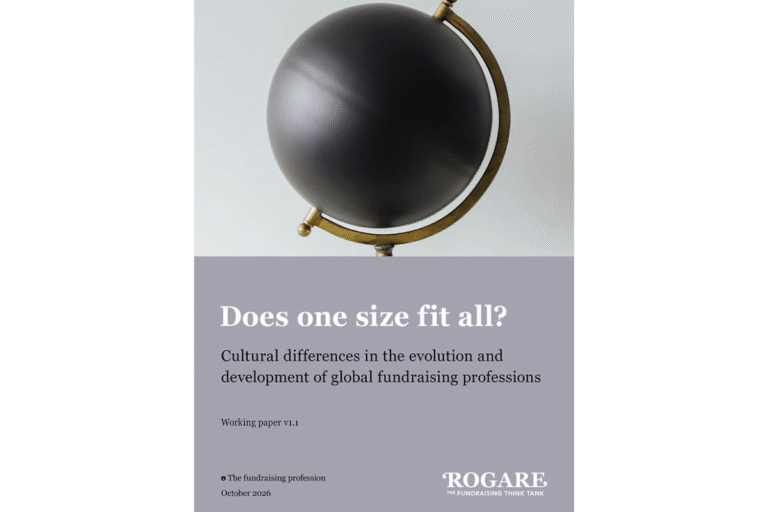
Rogare, the international fundraising think tank, has launched a project and working paper asking whether fundraising ideas developed in English-speaking countries are crowding out practices better suited to local cultures of philanthropy.
The paper, Does one size fit all? Cultural differences in the evolution and development of global fundraising professions, argues that much thinking about best practice, ethics and regulation originates in the “anglosphere” and is then exported to fundraising professions around the world. It asks whether those ideas always suit other cultures and, even where they do, whether they displace local approaches that might work better.
A roadmap, not a prescription
Rogare emphasises that it is not telling fundraisers in any country how to professionalise, which it calls inappropriate anglophone behaviour. Instead it offers a template that fundraisers can adopt or adapt. It recommends four stages:
Advertisement

- identify the characteristics of the local social culture;
- describe the local culture of philanthropy;
- compare anglophone best practice, ethics and standards with local values to see which fit and which are problematic;
- and consider the most appropriate forms of professionalisation.
The working paper draws on Geert Hofstede’s six-dimension model of national culture, and acknowledges criticisms of it. Rogare defines professionalisation as a group of fundraisers collectively moving their practice towards greater effectiveness, efficiency and accountability within their local culture of philanthropy. It says this “categorically does not mean” adopting the norms of any one culture.
Commission and ‘because of you’
The paper gives two examples. Paying fundraisers by commission is almost universally prohibited in the English-speaking world, but might be acceptable elsewhere, or might not: Rogare says it does not know.
Donor-centred fundraising‘s habit of singling out the donor for praise, the “because of you…” direct mail letter, reflects individualist anglophone culture and might not play well in more collectivist ones, such as those found in Asia.
Alice Ferris of US agency GoalBusters, a Rogare Associate Member and Council member, said:
“Calling something best practice doesn’t make it universally best, and the fundraising profession keeps mistaking its own reflection for a universal law.”
No universal ethics, and next steps
The key implication, Rogare argues, concerns ethics. Its Rights-Balancing Fundraising Ethics framework balances fundraisers’ duties to donors and to beneficiaries, and those duties may vary between cultures. A practice that is unethical in one culture, such as paying commission, could therefore be ethical in another, meaning “there can be no universal global standard of fundraising ethics”.
Rogare hopes to set up working groups in some countries and cultures, starting with Hopi Nation nonprofits in the USA in collaboration with GoalBusters. It has also held initial discussions with members of the Māori community in New Zealand/Aotearoa. Fundraisers who want to collaborate can contact Ian MacQuillin at cu******@****re.net. Rogare’s work is supported by its Associate Members, among them ST (Stephen Thomas Ltd), Ask Direct, GoalBusters, Giving Architects, Chell Perkins and Fundraiser in the Room, and by a strategic partnership with the Chartered Institute of Fundraising.
- Rogare issues warning as commission-based pay for fundraisers is deregulated (4 February 2026)
- Ian MacQuillin awarded outstanding contribution award at CIOF awards (8 June 2026)
- Values alignment not necessarily best basis for ethical decisions on refusing donations (6 November 2024)
Related posts
Think tank to develop fundraising ethics theory to support the profession
US and UK fundraisers need a theory of ethics, says fundraising think tank
Rogare presents new theory of fundraising ethics
Rogare project examines ethics of legacy fundraising during emergencies

About Howard Lake
Howard Lake is consultant editor of UK Fundraising. He founded the site in 1994 and successfully sold it in 2022. As director of Giving X Ltd he is exploring growing giving on a massive scale.
He is the founder of Fundraising Camp and co-founder of GoodJobs.