

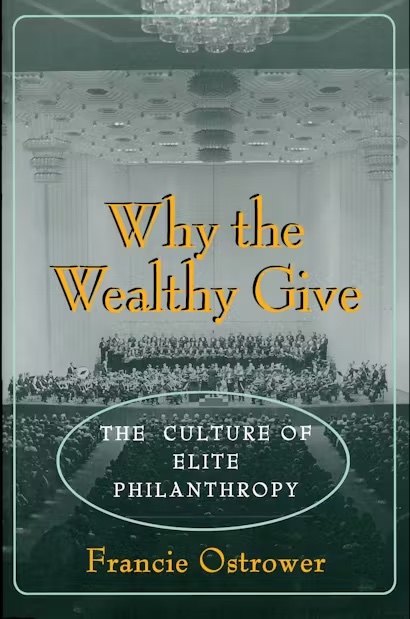
Why the Wealthy Give: The Culture of Elite Philanthropy
Why do wealthy people give? For the love of humanity, or the love of class? Based on candid interviews with nearly a hundred major donors, this landmark study by Harvard sociologist Francie Ostrower reveals that elite philanthropy is far more than charity. It is the cultural language through which the wealthy define who they are, mark out their status, and pass it on.
The question Francie Ostrower set out to answer seems simple: why do rich people give to charity? The answer her research uncovered is anything but. Drawing on in-depth personal interviews with ninety-nine major donors in the New York City area, one of the world’s highest concentrations of philanthropic wealth, Ostrower found that the motivations for elite giving are deeply embedded in the social and cultural life of the wealthy class itself.
Elite philanthropy, she shows, is far more than an expression of generosity or civic duty. The wealthy take philanthropy and adapt it into an entire way of life, as a vehicle for the social and cultural cohesion of their class.
Why do cultural institutions dominate?
This explains the overwhelming dominance of cultural institutions, such as opera houses, museums, symphony orchestras, private universities, among the causes that attract major gifts from the wealthy. These institutions are not merely good causes: they are the social spaces through which elite identity is constructed, maintained, and transmitted to the next generation. A seat on the board of a great cultural institution is both a philanthropic act and a marker of social arrival.
Variations within elite philanthropy
Ostrower also explores the significant variations within elite philanthropy. Donors whose primary identity is defined by ethnicity, religion, or gender — Jewish donors, women donors, donors from immigrant backgrounds — often diverge from the prestige hierarchy of their class, supporting different causes and operating through different networks. The result is a picture of elite giving that is at once more complex, more socially embedded, and more revealing of American class structure than the conventional picture of benevolent generosity allows.
For UK fundraisers seeking to understand and engage major donors, Why the Wealthy Give provides an analytical framework that applies well to the UK. British philanthropy has its own class dynamics, its own hierarchy of prestige institutions, and its own unspoken rules about which causes confer status and which do not. Ostrower’s methods and findings offer tools for thinking about these dynamics with a clarity that is rarely available from inside the fundraising relationship.
The book is a winner of the 1996 Virginia A. Hodgkinson Research Prize (Independent Sector) and co-winner of the 1996 ARNOVA Award for Distinguished Book in Nonprofit and Voluntary Action Research.
Originally published in hardback 1995, this listing uses the revised Princeton paperback.
About Francie Ostrower
Francie Ostrower is Associate Professor of Sociology at Harvard University. Why the Wealthy Give is based on her doctoral research at Columbia University and is widely regarded as the founding empirical study of elite philanthropic culture. She has subsequently held positions at the Urban Institute in Washington DC, where her research has focused on arts governance and nonprofit board behaviour.
Reviews
“This superb book will be required reading for scholars, fundraisers, nonprofit administrators, trustees, and anyone who is interested in the lives of the wealthy and well-born.”
Kathleen McCarthy, Director, Center for the Study of Philanthropy
“One of the finest pieces of social science research to emerge from the new academic field of philanthropic studies. This important book demonstrates that the most professionally rigorous forms of social science analysis can be presented in lucid prose and easily comprehended ideas.”
Choice
“I have found Why the Wealthy Give fascinating reading. Anyone involved in philanthropic foundations should read this book.”
Brooke Astor, philanthropist
“A milestone in the study of giving. Casts fresh light on aspects of donors’ philanthropic careers and motivations.”
Paul DiMaggio, Princeton University
- ARNOVA magazine reviews Why the Wealthy Give (11 April 1996)
Related books on UK Fundraising
- Generation Impact (Goldseker & Moody) for the motivations of the next generation of major donors;
- Strangers Drowning (MacFarquhar) for a more intimate exploration of extreme philanthropic commitment
- Limitarianism (Robeyns) for the philosophical challenge to elite wealth; Rich Expectations for the UK major donor landscape specifically.
