

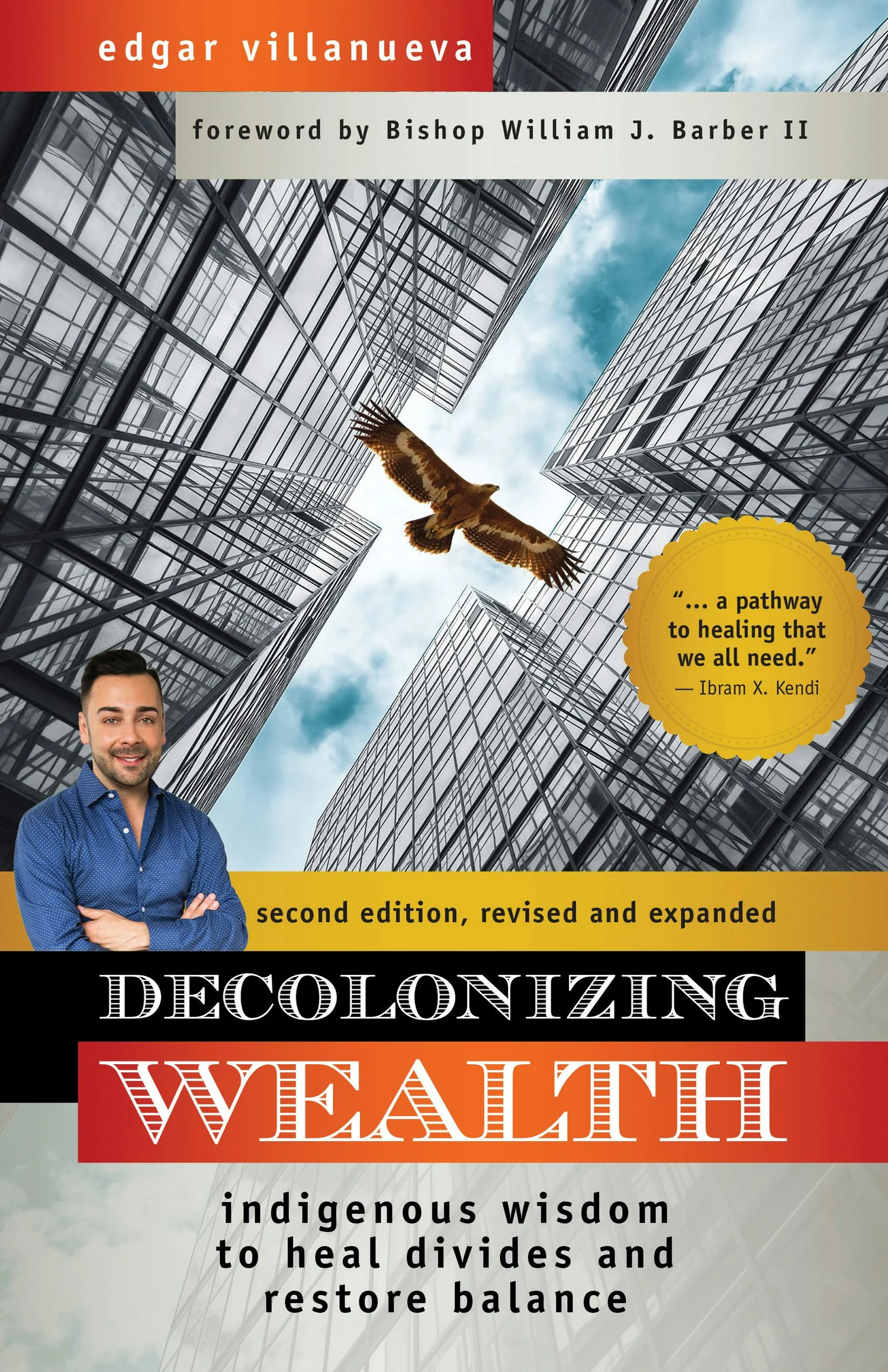
Decolonizing Wealth: Indigenous Wisdom to Heal Divides and Restore Balance
The philanthropic industry was built on a history of extraction, exclusion, and racial hierarchy, and it still reflects those origins today. In this landmark and deeply personal book, Edgar Villanueva draws on fourteen years inside US philanthropy and the traditions of his Native American heritage to diagnose the problem and prescribe the medicine. A book that has changed conversations about power and giving across the sector.
The $1 trillion philanthropic industry carries a name that means “the love of humankind” — yet its structures, practices, and distribution of power tell a different story. After fourteen years working at the heart of the sector, first at the Marguerite Casey Foundation and the Kate B. Reynolds Charitable Trust, then as Vice President of Programs and Advocacy at the Schott Foundation for Public Education, Edgar Villanueva had seen past philanthropy’s glamorous, altruistic façade. Behind it he found old boy networks, saviour complexes, internalised oppression among the rare people of colour who gained access, and a systematic reproduction of the colonial dynamics that had structured American life since the fifteenth century.
Decolonizing Wealth is Villanueva’s account of what he found, and what he believes must be done about it. Writing with the candour of an insider and the analytical tools of someone trained in the traditions of his Lumbee tribal heritage, he argues that philanthropy has evolved to mirror colonial structures: it reproduces hierarchy, concentrates decision-making power at the top, extracts value from communities while delivering inadequate returns, and ultimately does more harm than good, even when it is trying hardest to do good.
The framing is deliberately confrontational, but the prescription is not punitive. Drawing from Native American traditions of healing and reciprocity, Villanueva offers his Seven Steps to Healing as a practical pathway for individuals and institutions who want to genuinely change how they move money.
Second edition
This second edition, with a new foreword by Bishop William J. Barber II, expands the analysis beyond philanthropy into other sectors: entertainment, museums, libraries, land ownership, and more. It adds new examples of people using their resources to decolonise institutions, making it both more comprehensive and more practically useful than the first edition.
Decolonizing Wealth has become a touchstone text in US philanthropy, widely assigned in nonprofit management programmes and cited in sector-wide conversations about power, race, and equity. For UK readers, the historical specifics are American, the Indian boarding school system, the racial wealth gap rooted in slavery, the structural racism embedded in US grantmaking, but the underlying analysis applies wherever philanthropic power is concentrated in the hands of the predominantly white and wealthy.
The book sits naturally alongside Participatory Grantmaking in Philanthropy, No Such Thing as a Free Gift, and Winners Take All as essential reading for anyone thinking seriously about power dynamics in the sector.
About Edgar Villanueva
Edgar Villanueva is an award-winning author, activist, and nationally recognised expert on social justice philanthropy. He is an enrolled member of the Lumbee Tribe and the founder and principal of the Decolonizing Wealth Project and Liberated Capital, which use education, radical reparative giving, and narrative change to disrupt existing systems of moving and controlling capital. He has consulted with numerous philanthropic organisations on advancing racial equity and has written for the Stanford Social Innovation Review, the Chronicle of Philanthropy, and many other publications.
Reviews
“Only a truthful reckoning of our history of colonization can inform the transformation of our extractive economic systems. Recognition, repair, and transformation are not only moral imperatives — but they will also finally and truly benefit us all. Edgar Villanueva knows this deeply and is leading the way.”
Kat Taylor, philanthropist and co-founder, Beneficial State Bank
“If we are to escape the insidious hold racism has on our society, we must be intentional about truth and reconciliation. In Decolonizing Wealth, Edgar lays a foundation that not only explains the history of wealth and racism but also provides a pathway to healing that we all need.”
Ibram X. Kendi, National Book Award-winning author of Stamped from the Beginning
“Decolonizing Wealth is a call to action for all who seek real, meaningful progress. We need healing, we need hope, we need solidarity, and in this book, Edgar has provided the blueprint.”
Asha Curran, CEO, GivingTuesday
“Edgar Villanueva offers a new vision and an Indigenous perspective that can put us on a better path. Everyone should read Decolonizing Wealth, especially those who control the flow of resources in government, philanthropy, and finance.”
LaDonna Harris (Comanche), politician, activist and founder, Americans for Indian Opportunity
“Edgar’s voice will help shape the future of a philanthropy that systemically reverses the toxic inequalities that threaten the very fabric of our human existence.”
Pia Infante, Co-Executive Director, The Whitman Institute
“An important and provocative book that challenges all of us who work in philanthropy — and all of us who benefit from it — to examine our assumptions and change our practices.”
Alliance Magazine
Related books on UK Fundraising
- Participatory Grantmaking in Philanthropy (Gibson et al.) for the practical funder response to the same power dynamics
- No Such Thing as a Free Gift (McGoey) for a parallel structural critique from a sociological perspective
- Winners Take All (Giridharadas) for the broader elite philanthropy critique
- What Is Philanthropy For? (Davies), where Villanueva himself contributes an endorsement, for the UK philosophical perspective.
