


Cultural philanthropy strategy urged by think tank

Howard Lake | 22 November 2026 | News

The Cultural Policy Unit (CPU), an independent think tank for the arts, has called for a national strategy for cultural philanthropy. Its new report proposes tax relief for artists who donate their own work, a King’s Philanthropy Medal for Culture and a national match and seed-funding programme.
At a glance
- Report: A National Strategy for Cultural Philanthropy, by Alison Cole and Nathan Lloyd, published on 18 November 2026
- Three headline proposals: tax relief for artists’ own gifts, a King’s Philanthropy Medal for Culture, and a national match and seed-funding programme
- The annual cap on the Cultural Gifts Scheme and Acceptance in Lieu would rise from £40 million to about £63 million
- Context: public arts funding has declined over 15 years, and the CPU says self-generated income has not filled the gap
Advertisement
Why the CPU wants a national strategy
The report, A National Strategy for Cultural Philanthropy: Unlocking Private Investment in Britain’s Cultural Future, argues that philanthropy should be treated as “both an urgent strategic priority and a deliberate instrument of cultural policy”. It says Britain has a strong giving tradition but that its potential for cultural giving remains unrealised.
The CPU says UK tax incentives are broadly generous but structured very differently from those in France, Italy, Germany and the United States. It also points to the way British donors tend to give quietly and anonymously, whereas other systems reward public foundations and naming opportunities. It adds that Charities Aid Foundation data shows a marked decline in arts and culture giving over the past decade (UK Giving Report 2025).
Three headline proposals
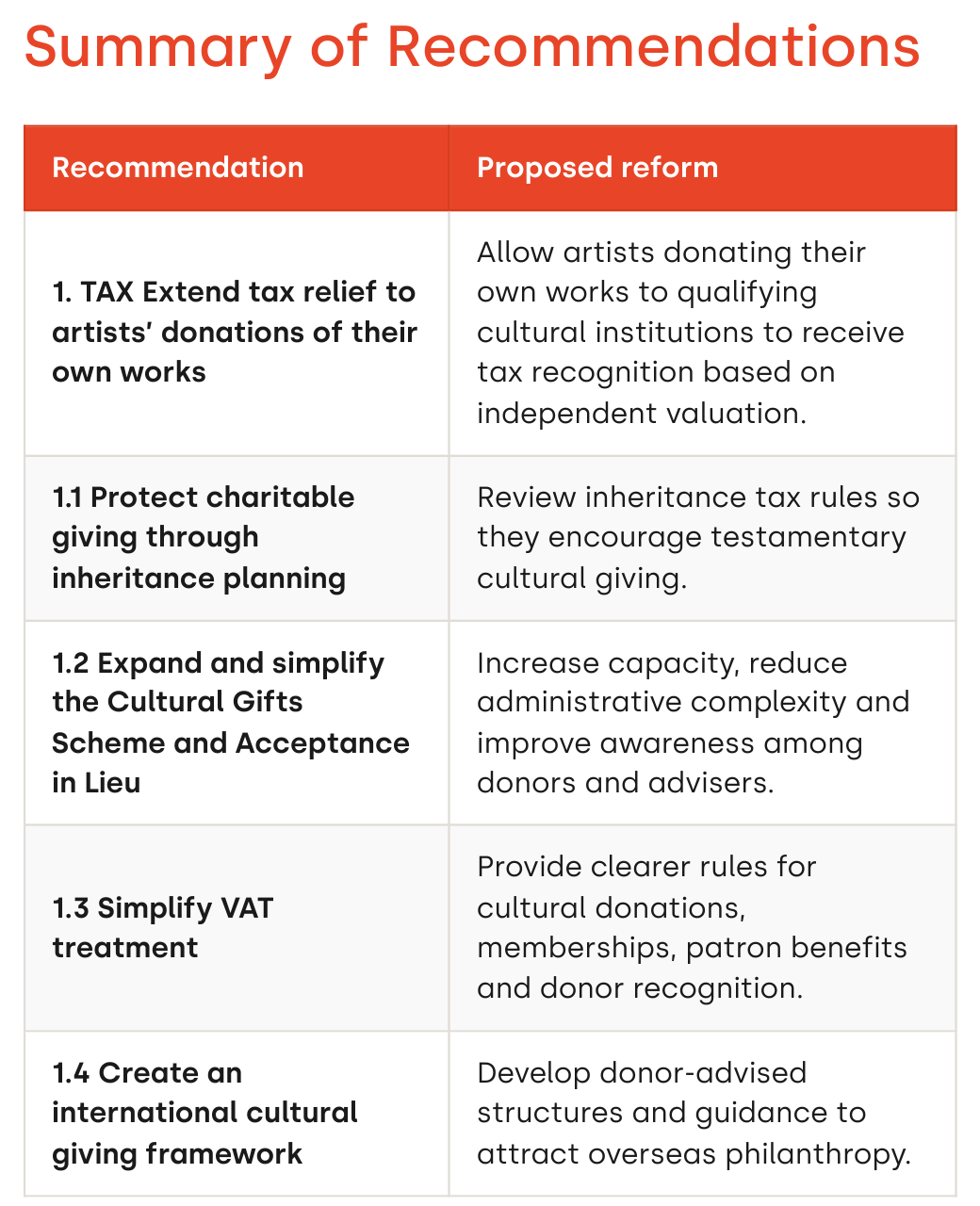
- Tax relief for artists. Artists who donate their own work to qualifying institutions would claim relief based on an independent valuation, such as that used for Acceptance in Lieu, and Gift Aid could then apply to that value. The report gives an example: a £10,000 artwork donated to a museum and later auctioned generates no Gift Aid, while a £10,000 cash gift would.
- A King’s Philanthropy Medal for Culture. It would recognise sustained giving with public benefit, not just wealth, and would be conferred by the King at an annual investiture. Overseas donors, smaller organisations and regional projects would be eligible.
- A national match and seed-funding programme. Each public pound would aim to attract a private one, with funding concentrated outside London and a seed-funding route for early-stage projects.
Wider tax, donor and delivery changes
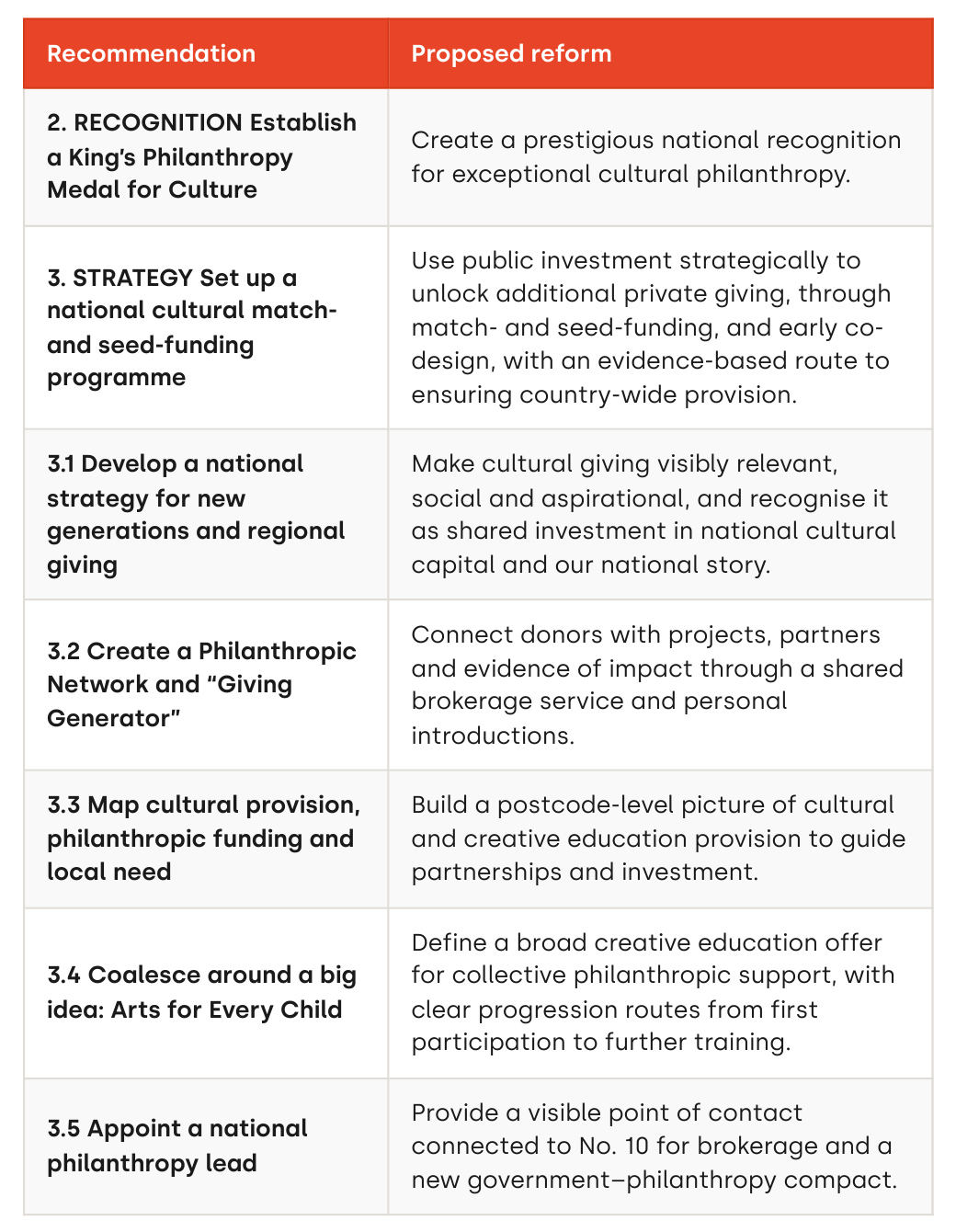
Beyond the three headline measures, the report proposes reviewing recent inheritance tax changes affecting gifts left on trust, simplifying the administration of the Cultural Gifts Scheme and Acceptance in Lieu, and clarifying VAT on minor donor benefits such as priority access and invitations. It also suggests culturally focused donor-advised funds and clearer guidance for overseas donors.
On donors, the CPU proposes a philanthropic planning qualification, a “philanthropic capital pot” for young people partly funded by Dormant Assets, and an online “Giving Generator” to match donors with projects by place, artform and purpose.
For delivery it wants a senior national philanthropy lead connected to No. 10, a government and philanthropy compact, and a cross-sector Cultural Philanthropy Taskforce. A postcode-level map of cultural and creative education provision would guide investment.
The evidence for match funding
The report leans heavily on the Big Give’s Arts for Impact campaign. In March 2024 it raised £2.85 million from 12,386 donations to 238 charities, including £1.3 million in match funding. Of those charities, 66 per cent had budgets under £1 million, and 76 per cent of the funds went outside London. A Big Give donor survey found that 84 per cent of donors said matching made them more likely to give.
At the other end of the scale, the report cites the National Gallery’s Project Domani, which has secured £375 million including two gifts of £150 million, and the Science Museum’s eight-figure gift from India’s Serum Institute, as examples of what focused giving can achieve.
How the sector has responded
Arts Professional reported that the Royal Shakespeare Company said the recommendations align with its belief that cultural philanthropy can unlock much needed funding for theatre and the wider arts sector.
The Art Newspaper quoted former National Gallery, National Portrait Gallery and Royal Academy head Charles Saumarez Smith, who called the report sensible and said the current systems, especially inheritance rules, are unclear even to many inside cultural institutions. Cultural strategy consultant Kate Rolfe said corporate donations also need new incentives.
On LinkedIn, Dr Steven Berryman of the National Centre for Arts Education welcomed the report’s call for a creative education for every child. Marina Jones of English National Opera valued the idea of mentored giving for younger donors, but said it was a shame that Arts for Impact is not running this year.
Artlyst was broadly supportive but raised concerns, including reliance on a small group of wealthy donors, whether a medal could reinforce inequality, safeguards against inflated artwork valuations, and whether government will provide the necessary support.
The full report is available from The Cultural Policy Unit.
- Government sets out roadmap to spread philanthropic investment beyond London (13 April 2026)
- Applications for Big Give’s second Arts for Impact match funding campaign now open (12 November 2024)
- Achates Philanthropy Prize returns to champion new donors amidst decline in UK giving (18 May 2026)


About Howard Lake
Howard Lake is consultant editor of UK Fundraising. He founded the site in 1994 and successfully sold it in 2022. As director of Giving X Ltd he is exploring growing giving on a massive scale.
He is the founder of Fundraising Camp and co-founder of GoodJobs.